

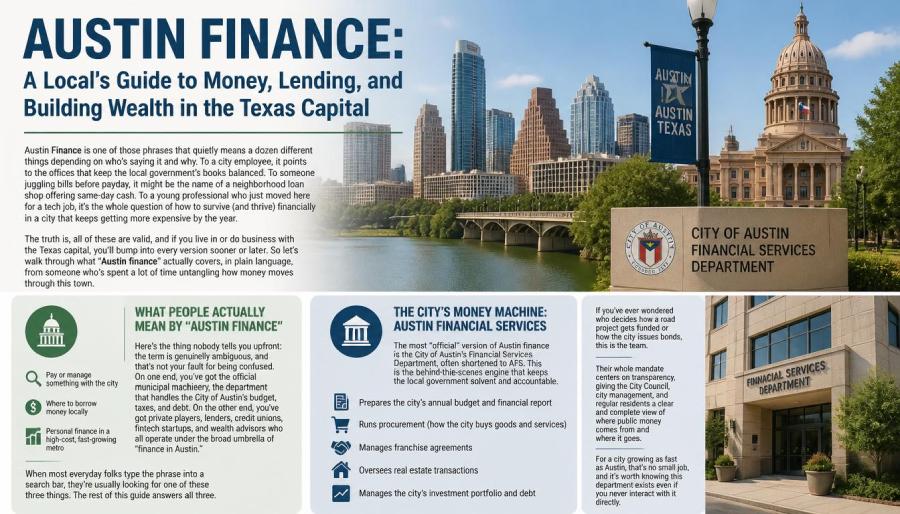
Austin Finance is one of those phrases that quietly means a dozen different things depending on who’s saying it and why. To a city employee, it points to the offices that keep the local government’s books balanced. To someone juggling bills before payday, it might be the name of a neighborhood loan shop offering same-day cash. To a young professional who just moved here for a tech job, it’s the whole question of how to survive (and thrive) financially in a city that keeps getting more expensive by the year. The truth is, all of these are valid, and if you live in or do business with the Texas capital, you’ll bump into every version sooner or later. So let’s walk through what “Austin finance” actually covers, in plain language, from someone who’s spent a lot of time untangling how money moves through this town.
What People Actually Mean by “Austin Finance”
Here’s the thing nobody tells you upfront: the term is genuinely ambiguous, and that’s not your fault for being confused. On one end, you’ve got the official municipal machinery, the department that handles the City of Austin’s budget, taxes, and debt. On the other end, you’ve got private players, lenders, credit unions, fintech startups, and wealth advisors who all operate under the broad umbrella of “finance in Austin.” When most everyday folks type the phrase into a search bar, they’re usually looking for one of three things: how to pay or manage something with the city, where to borrow money locally, or how to handle their personal financial life in a high-cost, fast-growing metro. The rest of this guide is built around answering all three, because honestly, you deserve the full picture rather than half of it.
The City’s Money Machine: Austin Financial Services
The most “official” version of Austin finance is the City of Austin’s Financial Services Department, often shortened to AFS. This is the behind-the-scenes engine that keeps the local government solvent and accountable. AFS handles the heavy lifting of preparing the city’s annual budget and financial report, running procurement (basically how the city buys goods and services), managing franchise agreements, overseeing real estate transactions, and watching over the city’s investment portfolio and debt. If you’ve ever wondered who decides how a road project gets funded or how the city issues bonds, this is the team. Their whole mandate centers on transparency, giving the City Council, city management, and regular residents a clear and complete view of where public money comes from and where it goes. For a city growing as fast as Austin, that’s no small job, and it’s worth knowing this department exists even if you never interact with it directly.
Austin Finance Online (AFO): The City’s Digital Front Desk
If AFS is the engine, then Austin Finance Online (AFO) is the dashboard you actually get to touch. It’s the city’s web portal for handling official financial business without standing in a line somewhere downtown. Through AFO, you can do a surprising range of things: file and pay your Hotel Occupancy Taxes, request or renew an operating license for a hotel or short-term rental property, and keep tabs on business opportunities and solicitations if you’re a vendor hoping to work with the city. Vendors can even register to be notified when new opportunities pop up that match the kinds of goods or services they offer. There’s also a “checkbook” feature that lets you see the city’s actual spending, the purchases departments make from third parties. For short-term rental hosts especially, AFO is the place you’ll come to know well, since those quarterly tax filings are due whether or not you owe anything that period.
Housing Money: The Austin Housing Finance Corporation
Tucked inside the broader Austin finance world is a piece that quietly shapes a lot of lives, the Austin Housing Finance Corporation, or AHFC. Created back in 1979 as a public, nonprofit corporation tied to the City of Austin, it exists for one core reason: making housing more affordable for low- and moderate-income residents. The Austin City Council actually serves as its board of directors, which tells you how seriously the city takes the mission. AHFC issues single-family and multi-family bonds to finance reasonably priced housing, and it helps deliver housing programs using federal funds from the U.S. Department of Housing and Urban Development. In a city where home prices and rents have climbed hard over the past decade, this kind of public housing finance is a big deal. If you’re a first-time buyer feeling priced out, or you work in affordable housing, AHFC is a name worth keeping on your radar.
Borrowing Locally: Small-Dollar and Family-Owned Lenders
Now let’s shift to the side of Austin finance that real people often search for in a pinch, local lending. Texas has a long tradition of small, locally and family-owned finance companies that step in when a bank says no. These outfits typically offer modest personal loans, sometimes same-day, for things like unexpected bills, car repairs, furniture, or just bridging a rough month. Some of them have been around since the 1990s and operate a handful of branches scattered across the state. Their pitch is usually built on being approachable and fast, “big enough to serve you, yet small enough to know you,” as one of them likes to say. And there’s a real human need they’re meeting. But here’s my honest expert caution: small-dollar, bad-credit loans often carry high interest rates and fees, so read every line of the agreement before you sign. These loans can absolutely help in an emergency, but they can also become a cycle if you’re not careful. Borrow only what you can realistically pay back, and treat it as a short-term bridge, not a long-term crutch.
Credit Unions and Community Banks: The Underrated Workhorses
If the loan shops are the emergency room of Austin finance, credit unions and local community banks are your everyday primary care. Austin is home to several member-owned financial institutions, including one that proudly calls itself the city’s largest locally-owned financial institution. The appeal of a credit union is pretty simple once you understand the model: they’re owned by their members rather than outside shareholders, so the incentive is to deliver fair products and solid service rather than to maximize profit for someone far away. That usually translates into better rates on savings, lower fees, and friendlier terms on auto loans and mortgages compared to the big national banks. For most Austinites trying to build a stable financial base, opening an account at a reputable local credit union is one of the most underrated, boring-but-brilliant moves you can make. It won’t feel exciting, but your wallet will thank you over the years.
The Fintech Wave: Austin’s Modern Money Scene
You can’t talk about Austin finance in this decade without talking about fintech, because the city has quietly become one of the country’s most interesting hubs for financial technology. Austin’s mix of tech talent, lower costs than Silicon Valley, and a steady inflow of ambitious founders has produced a genuinely impressive crop of financial startups. You’ll find credit-building companies helping people with thin or damaged credit histories establish a foundation, app-based platforms reimagining how everyday folks pay bills and report payments to the credit bureaus, and firms using AI and machine learning to offer fairer credit to people the traditional system overlooks. There are also companies tackling real estate financing, homeownership rewards, and small-business funding. What ties them together is a shared instinct that the old financial system left too many people behind, and that smart technology can widen the door. If you’re financially curious, watching Austin’s fintech scene is like getting a preview of where consumer finance is heading nationally.
Investing and Wealth Management in the Capital City
Beyond borrowing and banking, Austin finance also includes a growing community of wealth management and financial advisory firms, the people who help you grow and protect money once you’ve got some to work with. The city has independent advisory firms that have been around for decades, built on the idea that an advisor should act as a partner rather than a salesperson. These boutique firms tend to emphasize personalized planning, walking clients through retirement strategy, investment management, tax-smart decisions, and the messy real-life stuff like what happens to your money when life throws a curveball. There’s also a serious venture capital and private equity presence here, with funds that have helped fuel Austin’s rise as a tech center. Whether you’re a salaried professional building a retirement nest egg or a founder thinking about raising capital, the local ecosystem has options. The trick, as always, is finding an advisor whose incentives genuinely line up with yours, ideally a fiduciary who is legally bound to act in your interest.
The Cost-of-Living Reality You Can’t Ignore
Here’s the backdrop that colors every financial decision in this city: Austin isn’t cheap anymore, and pretending otherwise will hurt you. Over the past decade, the influx of high-paying tech jobs and out-of-state transplants has pushed up housing costs, rents, and the general price of living. That reality cuts two ways. On one hand, wages here are often higher than in many other parts of Texas, which helps. On the other hand, those higher wages can create a false sense of comfort that quietly gets eaten alive by rent, property taxes, and lifestyle creep. Texas famously has no state income tax, which is a genuine advantage, but the state makes up a lot of that through property taxes, which in the Austin area can be substantial. Smart Austin finance means accounting for the full picture, not just your paycheck, but what your housing, taxes, and daily life actually consume. Budget like the cost of living is real, because it absolutely is.
Building a Smart Financial Plan That Fits Austin
So how do you actually pull all this together into a plan that works? Start with the unglamorous fundamentals that hold up anywhere but matter even more in a high-cost city. Build an emergency fund first, ideally three to six months of expenses, so that you never have to lean on a high-interest loan when life surprises you. Get your everyday banking into a credit union or community bank with low fees. Be brutally honest about your housing budget, since in Austin that single line item can make or break your whole financial life. Tackle high-interest debt aggressively before you chase fancy investments. Then, once the foundation is solid, start putting money to work through retirement accounts and sensible investing, leaning on a trustworthy local advisor if your situation is complex. The beauty of this approach is that it’s not flashy and it’s not gimmicky, it’s just the steady, repeatable behavior that turns a good Austin income into actual long-term security.
Common Money Mistakes Austinites Make
Even sharp people slip up, so let me flag the traps I see most often around here. The first is buying or renting too much house because the city’s energy makes it feel like everyone is living large, when plenty of those people are quietly drowning. The second is treating a small-dollar emergency loan as a regular tool rather than a rare last resort, which is how short-term help turns into a long-term hole. The third is ignoring property taxes when budgeting for a home, then getting blindsided every year. The fourth is parking all your savings in a big national bank’s low-interest account when a local credit union would pay you meaningfully more. And the fifth, maybe the sneakiest, is assuming a high salary alone equals financial health, when in reality what you keep matters far more than what you earn. Dodge these five, and you’re already ahead of a huge chunk of the city.
FAQs
What is the difference between Austin Financial Services and Austin Finance Online?
Austin Financial Services (AFS) is the City of Austin department that manages the government’s overall finances, including the budget, procurement, debt, and investments. Austin Finance Online (AFO) is the public web portal you use to actually carry out specific tasks with the city, like paying Hotel Occupancy Taxes, renewing a short-term rental license, or tracking vendor opportunities. Think of AFS as the department and AFO as the online service window.
Are local Austin finance companies safe to borrow from?
Many local, family-owned finance companies in Texas are legitimate and can genuinely help in an emergency, but “safe” depends entirely on the terms. These small-dollar loans often carry high interest rates and fees, so always read the full agreement, confirm the lender is properly licensed in Texas, and borrow only what you can comfortably repay. Treat them as a short-term bridge rather than a recurring solution.
Is Austin a good city for fintech and financial services jobs?
Yes, Austin has grown into one of the stronger fintech hubs in the country, thanks to its deep tech talent pool, lower costs than Silicon Valley, and a steady stream of startups in credit-building, payments, lending, and real estate finance. Alongside the startups, there’s an established base of credit unions, advisory firms, and venture capital, which together create a healthy range of finance career opportunities.
How do property taxes affect personal finance in Austin?
Quite a lot, actually. Texas has no state income tax, which is a real advantage, but it offsets that with relatively high property taxes that can be significant in the Austin area. When you’re budgeting for a home, you need to factor property taxes into your monthly costs from the start, because overlooking them is one of the most common ways local buyers end up financially stretched.
Where should I keep my everyday money in Austin?
For most people, a reputable local credit union or community bank is one of the smartest choices. Because credit unions are member-owned rather than shareholder-driven, they tend to offer better savings rates, lower fees, and friendlier loan terms than large national banks. Austin has several well-regarded local institutions, including one that bills itself as the city’s largest locally-owned financial institution.
Conclusion
Austin finance, in the end, isn’t one thing, it’s a whole layered ecosystem that runs from the city’s official budget offices all the way down to the personal choices you make on a Tuesday afternoon. The official side keeps the government transparent and funds the housing programs and infrastructure that shape daily life here. The private side, the lenders, credit unions, fintech upstarts, and wealth advisors, gives you the tools to borrow, save, grow, and protect what you earn. The connective tissue running through all of it is the reality that Austin is a vibrant but increasingly expensive place to live, which means financial discipline here pays off more than it might somewhere cheaper. Whether you came to this looking for a city tax portal, a local loan, or just a smarter way to handle your money in the capital, the path forward is the same: understand the players, respect the cost of living, build your foundation before you reach for anything fancy, and never sign something you haven’t read. Do that consistently, and you’ll find that Austin can be just as good to your wallet as it is to your weekends.