

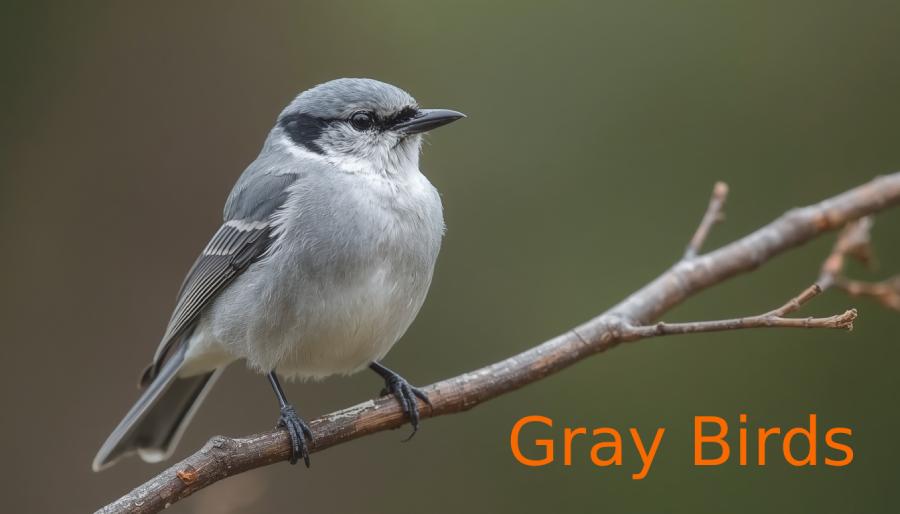
Gray Birds might sound like the most unremarkable category in the whole birding world, but anyone who has spent real time in the field knows that’s far from the truth. Gray is one of nature’s most underrated colors, and it shows up across an astonishing range of bird families, from tiny gnatcatchers no bigger than your thumb to bold jays that will happily steal a sandwich off your picnic table. The catch is that gray plumage doesn’t belong to one tidy group of related birds. It pops up in thrushes, flycatchers, doves, nuthatches, vireos, and even hawks and owls. That scattered distribution is exactly what makes gray birds such a fun and occasionally maddening puzzle to solve. In this guide, I’ll walk you through the most common gray birds you’re likely to run into, what sets each one apart, and the little tricks experienced birders use to tell near-identical species apart.
What Exactly Counts as a Gray Bird?
The honest answer is that “gray bird” is a loose, practical label rather than a scientific classification. When birders talk about gray birds, they’re simply describing the dominant impression a bird gives at first glance, and that impression is usually the most useful starting point for an identification. A bird doesn’t need to be gray from head to toe to land in this group. Plenty of species read as gray overall but carry small splashes of rust, black, or white that become the key to nailing down their identity. Because color cuts across family lines so freely, lumping these birds together by their shade is mostly a convenience for the eye and the field guide, not a statement about how closely related they are. Once you accept that, you stop expecting gray birds to behave like a single family and start treating each one on its own terms.
Why Gray Is Such a Tricky Color for Birders
Gray is deceptively slippery in the field, and it has everything to do with light. A bird that looks pale silver in bright midday sun can appear almost charcoal or even black when it’s tucked into the shade of a dense hedge, and that same bird might take on a brownish or bluish cast depending on the angle and time of day. This shape-shifting quality means you genuinely cannot trust color alone with gray birds the way you sometimes can with a brilliant red cardinal or a flash of blue jay. Experienced birders compensate by leaning hard on the other clues a bird offers: its size relative to familiar species, the shape of its bill and tail, how it moves through the vegetation, and the sounds it makes. Once you train yourself to read those features first and treat the gray as background information, identification becomes far less frustrating and a lot more reliable.
The Gray Catbird: A Mimic in Plain Clothes
If there’s a poster child for gray birds, it’s the Gray Catbird. At a quick glance it looks almost entirely slaty gray, but lean in a little and you’ll spot a neat black cap on the crown, a blackish tail, and a surprising patch of warm rufous-brown tucked underneath the tail. That hidden splash of color is one of the most satisfying little reveals in backyard birding. The catbird earns its name not from its looks but from its voice, which includes a cat-like “meow” that can genuinely make you glance around for a stray feline in the bushes. Beyond that signature mew, catbirds are accomplished mimics that string together long, rambling medleys of borrowed phrases. You’ll usually find them skulking through dense tangles of shrubs, vines, and forest edges, where they prefer quick, low flights over open ground rather than bold dashes across a clearing.
Mourning Doves and Their Gentle Presence
Few gray birds are as instantly recognizable, or as widespread, as the Mourning Dove. These soft, light gray to brownish-gray birds have a pale pinkish-tan wash across the breast and a long, tapered tail trimmed with white edges that flash when they take off. Their name comes from the low, mournful cooing that drifts across suburbs and farmland alike, a sound so common that many people stop noticing it entirely. Mourning Doves are ground feeders by preference, picking through grass and dirt for fallen seeds, which is why a simple ground tray or a scatter of seed beneath your feeder will reliably bring them in. They’re also known for a slightly comical, bobbing walk and for the sharp whistling sound their wings make on takeoff, an underrated identification clue that works even when you can’t see the bird clearly.
The Eurasian Collared-Dove: A Relative Newcomer
The Eurasian Collared-Dove is a fascinating example of just how quickly a bird can rewrite its own range. This pale gray dove isn’t native to North America at all; it only arrived on the continent in the 1980s, yet it has since spread across most of the country with remarkable speed. You can pick it out by its overall light grayish-buff coloring, the white patches in its tail, and most tellingly the thin black half-collar that wraps across the back of its neck like a partial necklace. It’s noticeably chunkier and paler than a Mourning Dove, with a squared-off tail rather than a pointed one, so once you’ve seen the two side by side the difference clicks into place. Collared-Doves are easygoing about food and habitat, happily visiting feeders and perching on telephone wires, which has helped fuel their rapid takeover of suburban and agricultural landscapes.
White-breasted Nuthatch: The Upside-Down Acrobat
The White-breasted Nuthatch is one of the most entertaining gray birds you can host at a feeder, mostly because of how it moves. While most birds climb up tree trunks, the nuthatch struts headfirst down them, defying gravity with a confidence that never gets old to watch. Color-wise it’s a tidy little package: clean white cheeks and breast, a blue-gray back, and a dark cap that runs black in males and a softer gray in females. Add in its stocky, almost neckless build, short tail, and long pointed bill, and you’ve got a bird that’s hard to mistake once you know it. Nuthatches are devoted feeder visitors with a particular love of sunflower seeds and suet, and they have a charming habit of grabbing a seed, wedging it into a bark crevice, and hammering it open, which is where the “nut-hatch” name actually comes from.
Canada Jay: The Bold Bird of the North
Head into the boreal forests and high country and you may meet the Canada Jay, a fluffy, fearless gray bird that has a long history of raiding campsites for an easy meal. For years birders knew this species as the Gray Jay, but the American Ornithological Society officially restored the name Canada Jay in 2018, even though plenty of longtime birders still slip and call it by the old name out of pure habit. Beyond its boldness, this jay has a genuinely remarkable life history. It raises its young in the depths of late winter, meaning the chicks grow up surrounded by cold and near-constant darkness, and unlike most songbirds it doesn’t bother attempting a second brood when spring arrives and conditions seem far more inviting. To pull off this winter nesting trick, Canada Jays spend the warmer months caching thousands of food items in tree bark, gluing them in place with sticky saliva to retrieve when the snow flies.
Northern Mockingbird: The Voice of a Hundred Birds
The Northern Mockingbird is a familiar gray bird across much of the United States, and while its plain gray body and white wing flashes are pleasant enough, its real claim to fame is its voice. A single mockingbird can imitate the songs of up to fifteen different species, and it tends to repeat each phrase a few times before rolling smoothly into the next, producing a near-endless stream of borrowed music. This vocal talent is actually one of the easiest ways to identify the bird, because that pattern of repeated, shifting phrases is unmistakable once you’ve heard it a few times. Mockingbirds are also bold and territorial, often perching prominently and flicking their tails, and in flight they reveal large white patches on the wings and tail that help confirm the sighting. They’re year-round residents in much of their range and seem perfectly comfortable living alongside people in parks, yards, and city neighborhoods.
Flycatchers: The Gray Birds You Identify by Ear
If gray birds have a final boss, it’s the flycatchers. Many of them, including phoebes, pewees, and the various Empidonax species, are so visually similar that even seasoned birders throw up their hands and admit that voice is often the only reliable way to separate them. The Eastern Phoebe, for instance, announces itself with a raspy “fee-bee” call and a constant downward pumping of its tail, and it has a fondness for nesting on human structures, especially under the eaves of buildings and bridges. The Willow Flycatcher looks almost identical to its cousins but gives a sneezy “fitz-bew” that gives it away. The lesson here is that with gray flycatchers, your ears will frequently outperform your eyes, so learning a handful of these signature calls pays off enormously. It’s also a good reminder that habitat and behavior, like where a bird perches and how it sits, can tip the scales when the plumage refuses to cooperate.
Dark-eyed Junco: The Little Snowbird
The Dark-eyed Junco is a gray bird that many people first notice in winter, when these tidy little sparrows show up beneath feeders in tight, busy flocks, which is exactly why they’ve earned the affectionate nickname “snowbird.” The most widespread form sports a smooth slate-gray hood and back set against a crisp white belly, and when a junco flushes you’ll catch a quick flash of white outer tail feathers that’s diagnostic on its own. What makes juncos a little tricky is that they come in several regional variations, ranging from the slate-colored birds common in the East to the more boldly patterned black, white, and brown forms out West, so the same species can look noticeably different depending on where you are. Like Mourning Doves, juncos are primarily ground feeders, hopping and scratching beneath shrubs and feeders for spilled seed, so a scatter of millet on the ground is the surest way to enjoy them up close during the colder months.
Small Grays Worth Knowing: Titmice and Gnatcatchers
Not every gray bird is dove-sized or bold; some of the most delightful are tiny and easy to overlook. The Tufted Titmouse is a soft gray, energetic little bird with a jaunty crest, big dark eyes, and a peachy wash along its flanks, and it’s a regular, lively presence at feeders where it grabs a single seed and flits off to crack it open elsewhere. The Blue-gray Gnatcatcher takes the small end even further, measuring barely four and a half inches with a wingspan of roughly six inches, and it can be picked out by its slate-gray upperparts, paler underparts, and a long black-and-white tail it constantly flicks and cocks. Gnatcatchers feed almost exclusively on insects and spiders, which means they’re less likely to visit feeders, but planting native, insect-friendly vegetation can coax them into a yard. Both of these little gray birds reward patience, because their constant motion and subtle markings make them feel like a genuine find every time.
How to Identify Gray Birds: Field Tips That Actually Work
When you’re staring at an unfamiliar gray bird and the field guide isn’t helping, the trick is to stop obsessing over the exact shade and start cataloging everything else. Begin with size, comparing the mystery bird to something you already know well, like a robin or a sparrow, because relative scale narrows the field fast. Next, study the shape of the bill and tail, since a thin warbler-like bill, a stout flycatcher bill, and a chisel-shaped nuthatch bill point you toward completely different families. Watch how the bird behaves, too, because climbing down a trunk, pumping a tail, or skulking in dense cover are each strong clues in their own right. Finally, listen, because for many gray birds, especially flycatchers and mimics, sound is the single most decisive piece of evidence you’ll get. Stack those observations together and the gray fades into the background while the bird’s true identity comes into focus.
Attracting Gray Birds to Your Backyard
The good news for anyone hoping to enjoy gray birds at home is that many of them are perfectly willing to visit, provided you offer what they’re looking for. A reliable supply of sunflower seeds and suet will pull in White-breasted Nuthatches and Tufted Titmice, while scattering seed or millet on the ground caters to Mourning Doves, Eurasian Collared-Doves, and Dark-eyed Juncos, all of which prefer to feed low. For the insect-eaters like gnatcatchers and catbirds, the best strategy isn’t a feeder at all but a yard rich in native plants, fruiting shrubs, and a bit of dense cover where they can forage and hide. Gray Catbirds in particular respond well to dried fruit on a platform feeder and to berry-producing bushes like dogwood and winterberry. Add a clean source of water and you’ll find that a surprisingly diverse cast of gray birds starts treating your yard as a regular stop.
FAQs
What is the most common gray bird in North America?
It’s hard to crown a single winner, but the Mourning Dove and the Northern Mockingbird are both strong contenders for the most commonly seen gray birds across the continent. Mourning Doves are nearly everywhere, from city parks to rural fields, and their gentle cooing is one of the most familiar bird sounds in North America. Mockingbirds are similarly widespread, especially in the southern and central states, and their endless mimicry makes them impossible to ignore once you tune in.
How do I tell two similar gray birds apart?
The most reliable approach is to look past the color entirely and focus on size, bill shape, tail shape, behavior, and especially sound. Two gray birds might look nearly identical in a photo, but one may climb headfirst down tree trunks while another pumps its tail or skulks in thick cover. For notoriously confusing groups like the flycatchers, voice is often the only dependable way to separate species, so learning a few signature calls will do more for you than any amount of staring.
Why do some gray birds look almost black?
This usually comes down to lighting rather than the bird’s actual plumage. Gray feathers absorb and reflect light in ways that can make a bird appear pale silver in bright sun and nearly charcoal or black in the shade. Birds like the Gray Catbird and Dark-eyed Junco are frequently described as looking darker than they really are simply because they were spotted in dim conditions or against a bright background, which fools the eye.
Are gray birds and “snowbirds” the same thing?
Not exactly, though there’s overlap. “Snowbird” is a common nickname specifically for the Dark-eyed Junco, a small gray sparrow that shows up at feeders in large numbers during winter. So while a snowbird is indeed a gray bird, not every gray bird is a snowbird. The term is tied to the junco’s seasonal arrival with the cold weather rather than to its color alone.
What should I feed to attract gray birds?
It depends on which gray birds you’re after. Sunflower seeds and suet are magnets for nuthatches and titmice, while seed or millet scattered on the ground brings in doves and juncos. For fruit-loving species like the Gray Catbird, dried fruit and berry-producing shrubs work wonders, and for strictly insect-eating birds like gnatcatchers, the real draw is a pesticide-free yard full of native plants that support plenty of bugs.
Conclusion
Gray birds prove that you don’t need flashy colors to be one of the most rewarding groups to watch and learn. What they lack in obvious brilliance they more than make up for in variety, character, and the genuine challenge of telling them apart. Once you stop treating gray as a dead end and start reading the subtler clues, the size, the shape, the behavior, and above all the sound, a whole hidden layer of the bird world opens up. From the meowing catbird and the gravity-defying nuthatch to the boreal-dwelling Canada Jay and the tireless mockingbird, these understated birds reward patience and attention in a way few others do. So next time a plain gray shape flits past, don’t write it off. Slow down, take a closer look, and let that quiet little bird show you exactly who it is.