

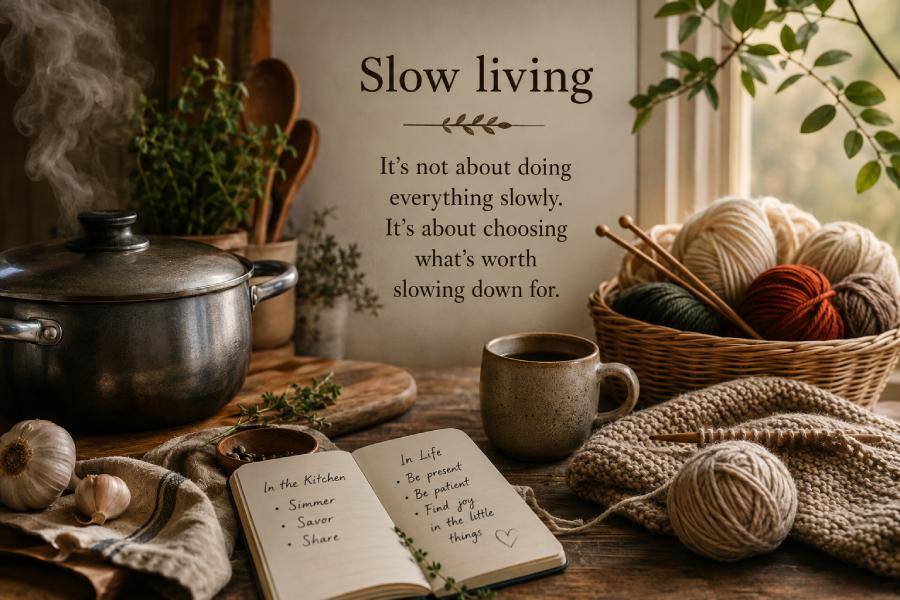
There’s a particular kind of satisfaction that comes from a meal cooked slowly in a well-worn pot, and an equally particular satisfaction that comes from a hand-knit blanket taking shape row by row over a quiet evening. Both are small acts of resistance against a culture that pushes speed and convenience above almost everything else.
Slow living has become something of a buzzword, but stripped of the aesthetic Instagram version, it’s really just a preference for doing fewer things, more deliberately, with tools that reward patience instead of punishing it.
Cookware Built for a Slower Kind of Cooking
Fast, convenience-driven cooking relies on nonstick coatings and shortcuts. Slow cooking, the kind that produces genuinely deep flavor, tends to rely on the opposite: heavy, well-distributed cookware that holds and releases heat evenly over long cook times.
That’s part of why home cooks drawn to slower, more intentional meal preparation often gravitate toward classic, durable cookware like the pieces from Magnalite, since even heat distribution matters enormously for the kind of low-and-slow cooking that defines this style of home cooking. A pot that heats unevenly rushes a cook into shortcuts a good pot never requires.
The Parallel Pull Toward Handcraft
Slow cooking has a natural companion in slow crafting, and it’s no coincidence that a lot of people drawn to one eventually find themselves drawn to the other. Both offer the same basic reward: a tangible result that took real time and attention to produce, rather than something purchased instantly and consumed just as quickly.
Crafters embracing this slower pace often build a rotating project list stocked with quality materials from Loops & Threads, since a good yarn or fiber choice makes the difference between a project that feels satisfying to work on and one that feels like a chore from the first row.
Why Slowness Feels Like a Luxury Now
It’s worth naming why slow living resonates so strongly right now. Most of daily life has been optimized for speed, fast food, instant messaging, same-day delivery, to the point where genuinely slow activities have become a rare and valued exception rather than the norm they once were.
That scarcity is exactly what makes a slow-cooked meal or a hand-crafted project feel meaningful in a way a quick alternative rarely does. The time itself has become part of the value, not just an inconvenience to minimize.
Making Room for Slowness in a Busy Schedule
The honest challenge with slow living is fitting it into schedules that are anything but slow. The solution isn’t finding huge blocks of free time, it’s protecting smaller, consistent pockets, a Sunday afternoon simmer, twenty minutes of knitting before bed, rather than waiting for a mythical free weekend that rarely materializes.
Consistency matters more than duration here. A regular twenty-minute slow-living ritual accomplishes more over months than sporadic, ambitious attempts that burn out quickly.
Choosing Tools That Actually Support the Practice
Both slow cooking and slow crafting fall apart quickly with the wrong tools. Cookware that heats unevenly turns a relaxing simmer into a stressful monitoring session. Poor-quality yarn snags and frustrates, turning what should be meditative into something aggravating.
Investing a little more upfront in tools genuinely suited to slow, deliberate use removes exactly the friction that causes people to abandon these practices after a few frustrating attempts.
The Social Side of Slow Living
Slow cooking and crafting both lend themselves naturally to sharing, a simmering pot that draws people into the kitchen, a finished knitted piece that becomes a genuine gift rather than a purchased one. That social dimension is part of what makes these practices sustainable long-term, rather than purely solitary hobbies that are easy to let slide.
Getting Started Without Overcommitting
For anyone curious about slow living but intimidated by the commitment, start with one practice, not both at once. Pick whichever appeals more, a long-simmered dish this weekend or a simple crochet project, and let genuine enjoyment, rather than obligation, determine whether it becomes a lasting habit.
What Slow Living Isn’t
It’s worth clearing up a common misconception: slow living isn’t about doing everything slowly, nor is it about rejecting convenience entirely on principle. It’s about being selective, choosing a small number of activities where the time itself adds genuine value, and remaining perfectly happy to move quickly through the rest of life’s obligations that don’t benefit from extra deliberation.
That selectivity is what makes slow living sustainable rather than an exhausting, all-encompassing lifestyle overhaul that most people abandon within a few weeks of trying to adopt it wholesale.
A Note on Passing This Down
For those with kids or younger family members, slow cooking and crafting offer a rare opportunity to model patience and delayed gratification in a genuinely enjoyable way, not as a lecture, but as a shared activity. A kid who helps stir a slow-simmering sauce or learns a basic crochet stitch is absorbing a lesson about patience that’s far more effective than being told to simply be more patient.
A Final Nudge to Just Start
None of this requires perfect conditions or a fully stocked kitchen and craft closet to begin. Pick one recipe, one small project, and start this week rather than waiting for the ideal weekend. Momentum, more than planning, is usually what turns a one-off attempt into a lasting practice.
A Closing Thought on Presence
Both slow cooking and slow crafting share one final, quiet gift: they pull attention fully into the present moment in a way few other activities manage. In a world constantly pulling focus in a dozen directions, that alone might be reason enough to keep a pot simmering or a project growing, row by row.
Bringing It All Together
Slow living isn’t about rejecting modern convenience entirely. It’s about choosing, deliberately, where speed genuinely doesn’t matter and where a little more time actually produces something better. A well-made pot and a good skein of yarn are small, unglamorous tools, but they’re exactly the kind of tools that make a slower, more intentional life practically possible rather than just aspirational.