

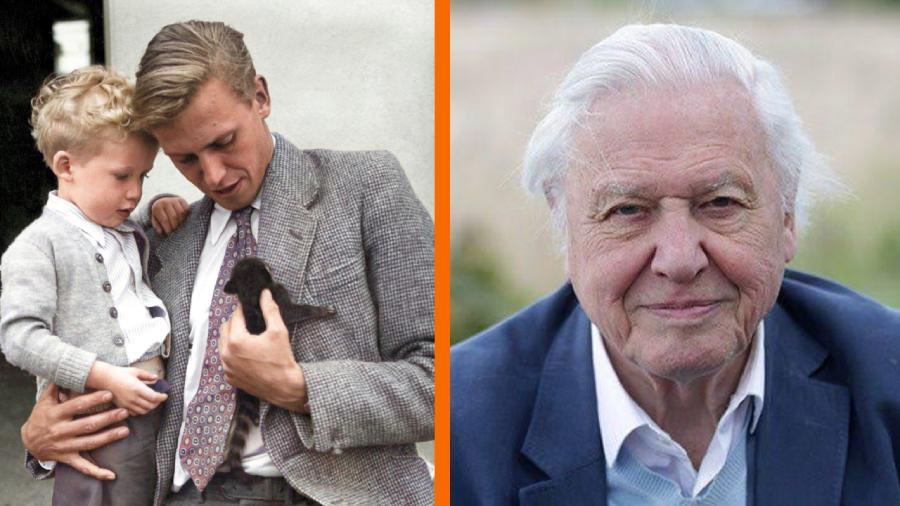
When the surname Attenborough enters a conversation, most minds travel immediately to sweeping nature documentaries, to the gentle authority of a voice that has narrated the wonders of life on Earth for over seven decades. Sir David Attenborough is, without question, one of the most recognized and beloved figures in the history of broadcasting. Yet behind the cameras, beyond the reach of microphones and television lights, there exists a figure whose story is just as fascinating — though far less familiar. Robert Attenborough, the elder child of David Attenborough and his late wife Jane Elizabeth Ebsworth Oriel, has spent his entire adult life pursuing a career that mirrors his father’s devotion to the natural world, but from a radically different vantage point. Rather than travelling with film crews to capture the behavior of animals across every continent, Robert chose the quiet corridors of universities, the meticulous discipline of laboratory research, and the deep intellectual challenge of understanding humanity itself through the lens of biological anthropology. His story is one of deliberate choices, scholarly excellence, and a principled commitment to privacy that stands in sharp contrast to the global fame that surrounds his family name. In 2026, as Sir David Attenborough approaches the extraordinary milestone of his hundredth birthday, public curiosity about the Attenborough family has never been greater — and Robert’s untold story deserves to be understood on its own terms.
Quick Information Table
| Detail | Information |
|---|---|
| Full Name | Robert Attenborough |
| Year of Birth | 1951 |
| Age (as of 2026) | Approximately 74–75 years old |
| Father | Sir David Attenborough |
| Mother | Jane Elizabeth Ebsworth Oriel (1926–1997) |
| Sibling | Susan Attenborough (younger sister) |
| Nationality | British |
| Profession | Biological Anthropologist and Academic Researcher |
| Primary Institution | Australian National University (ANU), Canberra |
| Role at ANU | Former Senior Lecturer in Bioanthropology |
| Current Academic Status | Honorary Senior Lecturer at ANU |
| University Affiliation (UK) | University of Cambridge, Department of Archaeology |
| Research Focus | Human population biology, evolutionary ecology, health in Papua New Guinea |
| Notable Publication | Human Biology in Papua New Guinea: The Small Cosmos |
| Business Role | Director of David Attenborough (Productions) Limited since 1997 |
Early Life and Family Background
Robert Attenborough was born in 1951, just one year after his parents, David Attenborough and Jane Elizabeth Ebsworth Oriel, were married. He arrived into a household that was already beginning to orbit around one of the most exciting careers in British broadcasting. His father had joined the BBC in the early 1950s and was rapidly building a reputation as a young presenter with a gift for making the natural world accessible and thrilling to ordinary viewers. For Robert, childhood was anything but conventional. While most children of the era were content with toy soldiers and picture books, the Attenborough household was a revolving door of specimens, exotic animals, and stories from the far corners of the planet. David Attenborough’s early programme, Zoo Quest, which began in 1954, required him to travel extensively to collect animals for the London Zoo while filming their habitats. The consequence was that Robert grew up surrounded by creatures most British children would never see outside a textbook. One memorable story, recounted by David himself in several interviews, involved a salamander gifted to Robert on his eighth birthday. When the young boy placed the animal into its new enclosure, the salamander gave birth right there on his hand — an astonishing moment that left both father and son speechless with wonder. It was precisely this kind of experience, rooted equally in surprise and scientific curiosity, that would shape Robert’s intellectual future. His mother, Jane Elizabeth Ebsworth Oriel, played an indispensable role in maintaining stability and normality at home while David was away on his filming expeditions for months at a stretch. Jane provided the grounding presence that allowed both Robert and his younger sister Susan to thrive despite their father’s frequent absences.
Growing Up in the Shadow of Fame
Growing up as the child of a national treasure comes with a unique set of pressures that few people can fully appreciate. For Robert Attenborough, the challenge was compounded by the sheer scale of his father’s cultural impact. David Attenborough was not merely a television presenter; he was becoming one of the defining voices of an era, a man whose programmes were watched by tens of millions. Robert and his sister Susan navigated this reality with a remarkable absence of public drama. Neither child ever sought to trade on the family name, and neither showed any inclination toward the entertainment industry that had made their father and their uncle, the acclaimed actor and director Sir Richard Attenborough, internationally famous. This deliberate withdrawal from public life appears to have been a family value as much as an individual choice. David Attenborough himself has always been protective of his children’s privacy, rarely discussing them in interviews and offering only occasional, affectionate glimpses into their lives. The household operated on a foundation of intellectual curiosity, mutual respect, and a preference for substance over spectacle. Robert absorbed these values thoroughly, carrying them into an adult life that prioritized scholarly contribution over public recognition.
The Relationship Between Robert and David Attenborough
Sir David Attenborough has spoken publicly, though sparingly, about the personal cost of his extraordinary career. In a 2017 interview, he admitted with characteristic honesty that his prolonged absences during Robert and Susan’s formative years represented a genuine loss. He acknowledged that missing three months of a young child’s life is irreplaceable, and that no amount of professional achievement can fully compensate for those gaps. The family eventually processed this difficult reality with warmth and humor. David recalled that family jokes became a way of acknowledging the absences without allowing them to become sources of lasting resentment — his children would tease him about events and milestones he had missed because he was filming in some distant jungle or ocean. Despite these separations, the relationship between Robert and his father remained strong throughout their lives. They shared a profound respect for the natural world and a belief in the importance of rigorous inquiry. Robert may have chosen a different arena for his work, but the underlying values — patience, observation, humility before the complexity of nature — were clearly inherited. In 2026, as David approaches the landmark of his hundredth birthday, Robert’s presence in the family circle has become more visible, even if he continues to avoid the media spotlight himself.
Academic Career at the Australian National University
Robert Attenborough’s professional life has been defined by his long and productive association with the Australian National University in Canberra. He joined ANU in 1981, a move that took him halfway around the world from his British roots and established him in one of the Southern Hemisphere’s most respected research institutions. At ANU, he served as a Senior Lecturer in Bioanthropology within the School of Archaeology and Anthropology, a position he held for more than three decades before his retirement in 2013. His responsibilities encompassed both teaching and research, and he was known among colleagues and students for his rigorous approach to scholarship, his insistence on ethical fieldwork practices, and his ability to guide students through the complex intersections of biology, culture, and human evolution. ANU provided Robert with the institutional support and intellectual freedom to pursue research questions that genuinely mattered to him, far removed from the pressures of public performance or media engagement. Even after his formal retirement, Robert maintained his connection to ANU as an Honorary Senior Lecturer, a title that reflects the enduring respect he commands within the academic community. His decades at ANU represent not just a career, but a sustained commitment to a particular vision of what academic life should be — patient, thorough, and driven by genuine curiosity rather than the pursuit of fame or financial reward.
Research in Papua New Guinea and Human Population Biology
The heart of Robert Attenborough’s scholarly contribution lies in his extensive research on the human populations of Papua New Guinea. This region, one of the most culturally and biologically diverse places on Earth, became the geographic and intellectual center of his life’s work. Robert’s research explored how isolated human communities adapt to challenging environments over long periods of time, examining the complex relationships between genetics, nutrition, health, disease, and cultural practice. His fieldwork required him to spend significant time in remote communities, building trust and understanding with populations that had limited contact with the wider world. This kind of research demands not only scientific expertise but also a deep ethical sensitivity and a willingness to listen rather than impose. Robert’s work contributed to a broader understanding of human biological diversity and the ways in which populations evolve in response to their specific ecological circumstances. His notable publication, Human Biology in Papua New Guinea: The Small Cosmos, became an important reference in the field, offering detailed insights into the demography, health patterns, and biological characteristics of New Guinean populations. The work demonstrated that even small, isolated communities can reveal fundamental truths about human biology and evolution — truths that have implications far beyond the geographic boundaries of the study itself.
Connection to the University of Cambridge
In addition to his long career at the Australian National University, Robert Attenborough maintained significant academic ties with institutions in the United Kingdom, most notably the University of Cambridge. His association with Cambridge’s Department of Archaeology provided him with a foothold in the British academic world and allowed him to participate in research networks that spanned multiple continents and disciplines. Cambridge, with its centuries-old tradition of scholarly excellence, was a natural intellectual home for someone of Robert’s caliber and interests. Following his retirement from ANU, Robert continued his research work in connection with Cambridge, ensuring that his expertise and insights remained available to the wider academic community. This dual institutional affiliation — Australian and British — reflects the international character of modern biological anthropology, a field that by its very nature crosses national and cultural boundaries. Robert’s ability to operate comfortably in both academic environments speaks to his adaptability and to the universal relevance of the questions his research addressed.
Business Involvement and the Attenborough Legacy
While Robert Attenborough’s primary identity has always been that of a scholar and researcher, he has also played a quiet but significant role in managing aspects of his father’s professional legacy. Since February 1997, Robert has served as a director of David Attenborough (Productions) Limited, the company that oversees certain business aspects of Sir David’s extraordinary body of work. This role, though rarely discussed in public, demonstrates that Robert has not been entirely detached from his father’s career — rather, he has contributed to its management and continuity from behind the scenes. The timing of his appointment, coinciding with the year of his mother Jane Elizabeth Ebsworth Oriel’s passing, suggests that Robert may have stepped into a more active family role during a period of significant personal transition. His willingness to take on this responsibility, alongside his demanding academic career, reveals a man capable of balancing multiple commitments with discretion and competence.
The Private Life of Robert Attenborough
One of the most striking aspects of Robert Attenborough’s life is the degree to which he has maintained his personal privacy. In an era when the children of famous figures frequently become public personalities in their own right — whether through social media, television appearances, or the inevitable curiosity of tabloid journalism — Robert has managed to keep the details of his private life almost entirely out of public view. Information about his romantic relationships, whether he has children of his own, and the daily texture of his personal existence remains largely unknown. This is not an accident or an oversight; it is a deliberate and sustained choice that reflects both Robert’s character and the values of the Attenborough family as a whole. His father David has always been careful to draw a boundary between his public role as a broadcaster and his private life as a parent and family man, and Robert appears to have inherited this instinct completely. In 2026, despite the intense public interest generated by Sir David’s approaching centenary, Robert continues to guard his privacy with quiet determination.
Susan Attenborough and the Sibling Bond
Robert Attenborough’s younger sister, Susan Attenborough, has followed a path that is similarly removed from the glare of public attention. Susan spent much of her career as a primary school headteacher, a profession that, like Robert’s academic career, prioritizes service and contribution over visibility. In more recent years, Susan has taken on a role supporting her father’s administrative and professional affairs, working closely with David as he continues to remain active well into his late nineties. The bond between Robert and Susan appears to have been shaped by their shared experience of growing up with a father whose work took him away from home for extended periods and a mother, Jane Elizabeth Ebsworth Oriel, who held the family together with quiet strength. Both siblings chose careers rooted in education and knowledge, and both have demonstrated a consistent preference for meaningful work over public recognition. Their parallel choices suggest that the values instilled by their parents — intellectual curiosity, personal modesty, and a commitment to contributing positively to the world — took deep root in both children.
Robert Attenborough’s Legacy in Anthropology
Although Robert Attenborough’s name may never carry the instant global recognition that his father’s does, his contributions to the field of biological anthropology are substantial and enduring. His decades of research on human populations in Papua New Guinea have advanced our understanding of how human biology intersects with culture, environment, and evolutionary history. His teaching at the Australian National University shaped generations of students who went on to pursue their own careers in anthropology, archaeology, and related disciplines. His publications remain important reference points for researchers working in similar areas. In a field that values careful, sustained inquiry over dramatic breakthroughs, Robert’s body of work represents exactly the kind of contribution that matters most — incremental, rigorous, and deeply informed by firsthand experience. His legacy is not measured in television ratings or public awards, but in the quality of the knowledge he has helped to create and the researchers he has helped to train. In the broader context of the Attenborough family’s contributions to our understanding of the natural world, Robert’s work occupies a vital and complementary position, extending the family’s intellectual reach into the domain of human biology and evolution.
The Attenborough Family in 2026
The year 2026 carries special significance for the Attenborough family. Sir David Attenborough, born on May 8, 1926, reaches the remarkable age of one hundred — a milestone that has generated enormous public interest and affection around the world. For Robert, now in his mid-seventies, this moment represents both a celebration and a period of reflection. The family has weathered significant losses over the years, including the death of Robert’s mother Jane Elizabeth Ebsworth Oriel in 1997 and the passing of his uncle Sir Richard Attenborough in 2014. Through these losses and changes, the family has remained cohesive, bound together by shared values and mutual loyalty. Robert’s role within the family in 2026, while not publicly detailed, is understood to be that of a supportive and present son who continues to balance his academic interests with his family responsibilities. The centenary of David Attenborough is not just a personal milestone for the family; it is a cultural event of national and international significance, and Robert’s quiet presence within it reflects the essential character he has maintained throughout his life.
Why Robert Attenborough’s Story Matters
In a culture that increasingly equates value with visibility, Robert Attenborough’s life offers a powerful alternative narrative. He was born into a family that could have provided easy access to fame, wealth, and public influence. His father is a global icon. His uncle was an Oscar-winning filmmaker. The Attenborough name opens doors that remain closed to most people. Yet Robert chose a path defined by intellectual rigor, personal modesty, and a genuine commitment to advancing human knowledge through careful, patient research. His story matters because it reminds us that success is not a single thing — it is not limited to the accumulation of public recognition or material wealth. Robert Attenborough built a career that contributed meaningfully to our understanding of human biology and evolution. He mentored students, conducted ethical fieldwork in some of the most remote communities on Earth, and produced scholarship that will endure long after the news cycles of any given year have faded. His life is a testament to the idea that quiet dedication, pursued with integrity over decades, constitutes its own form of greatness.
Conclusion
Robert Attenborough’s story is, in many ways, the untold counterpart to one of the most celebrated public lives of the twentieth and twenty-first centuries. While Sir David Attenborough brought the wonders of the natural world into millions of homes around the globe, his son Robert devoted himself to understanding the most complex creature of all — the human being. Born into a family where intellectual curiosity was as natural as breathing, raised by a mother, Jane Elizabeth Ebsworth Oriel, whose steadfast presence allowed both her children to flourish, and shaped by a father whose passion for the living world was boundless, Robert forged his own identity with quiet conviction. His career at the Australian National University, his groundbreaking research in Papua New Guinea, his continued association with Cambridge, and his behind-the-scenes role in managing his father’s professional legacy all point to a life lived with purpose, integrity, and a deep sense of responsibility. In 2026, as the world celebrates David Attenborough’s centenary, it is worth pausing to acknowledge that the Attenborough legacy extends well beyond the reach of television cameras. Robert Attenborough may have chosen a life away from the spotlight, but the light of his contributions to science and scholarship shines with its own steady and enduring brightness.