

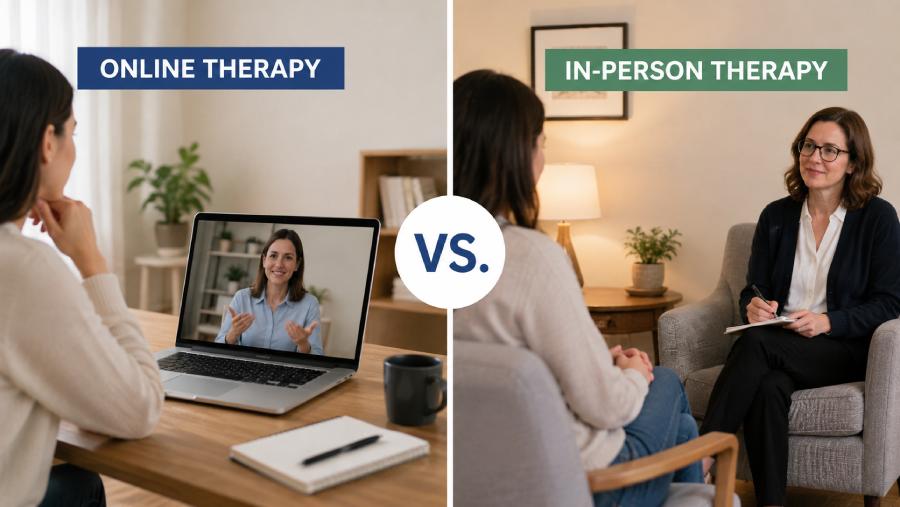
Choosing between online therapy and in-person counseling can feel surprisingly complicated, especially when both options promise real, meaningful support. The honest truth is that neither format is universally better. What works depends on your schedule, your mental health needs, where you live, and even how you personally connect with people. Understanding the genuine differences between these two paths makes the decision a lot cleaner.
This article walks through how online and in-person therapy compare across several practical dimensions: access, effectiveness, cost, privacy, and the kinds of conditions each format handles well. By the end, you should have a clearer picture of which setting fits your current situation.
How Access Differs Between Online and In-Person Therapy
Geography shapes mental health care more than most people realize. According to the Health Resources and Services Administration, more than 160 million Americans live in areas designated as mental health professional shortage areas. Rural counties often have just one or two licensed therapists serving entire communities. That scarcity makes traveling to weekly in-person appointments impractical for a significant portion of the population.
Online therapy removes that geographic barrier almost entirely. A person living two hours from the nearest psychiatrist can attend a video session from their kitchen table. The only real requirements are a stable internet connection and a private space to talk. For people managing chronic illness, physical disabilities, or demanding caregiving responsibilities, that convenience is not a luxury. It is what makes treatment possible at all.
In-person therapy still holds an access advantage in one specific scenario: individuals who lack reliable broadband or who are unfamiliar with video platforms may find a physical office easier to use. Some older adults and people in certain lower-income households fall into this category. Access is never one-size-fits-all.
What the Research Says About Effectiveness
Effectiveness is the question most people care about first, and the research is genuinely reassuring. A 2022 meta-analysis published in the journal World Psychiatry reviewed data from dozens of randomized controlled trials and found that video-based cognitive behavioral therapy produced outcomes equivalent to face-to-face delivery for conditions including depression, anxiety disorders, and PTSD. Symptom reduction rates were statistically similar across formats.
That said, effectiveness is not absolute. Some therapeutic modalities are harder to replicate online. EMDR therapy, which involves specific eye movement protocols, has been adapted for telehealth but requires careful setup. Certain somatic therapies that involve physical cues or touch cannot translate to a screen at all. Intensive programs that involve group work, skill-building exercises, or coordinated care between multiple providers may also run more smoothly in a shared physical space.
For the large majority of people seeking talk-based therapy, though, the clinical outcomes appear to be comparable. The therapeutic alliance, meaning the quality of the relationship between client and therapist, has been shown to develop effectively through video just as it does in person.
Cost and Insurance: Breaking Down the Numbers
Cost is a major factor for most people, and the comparison is more nuanced than it first appears. Online therapy platforms sometimes advertise lower session rates, but those rates can vary widely depending on the provider, the level of licensure, and whether insurance is accepted. A session with a licensed psychologist through a telehealth platform may cost the same as, or more than, a local therapist who accepts your insurance plan.
| Cost Factor | Online Therapy | In-Person Therapy |
| Average session rate (self-pay) | $60 to $200 per session | $100 to $250 per session |
| Insurance acceptance | Increasingly common; varies by platform | Widely accepted by most licensed providers |
| Transportation costs | None | Gas, parking, or transit fares apply |
| Time cost per session | Minimal; no commute | Commute adds 30 to 90 minutes typically |
| Subscription model availability | Common on major platforms | Rare; usually fee-per-session |
Since the COVID-19 pandemic, most major U.S. insurers have expanded telehealth coverage, and many states now require parity between telehealth and in-person mental health benefits. The Kaiser Family Foundation reported in 2023 that telehealth utilization stabilized at rates roughly 38 times higher than pre-pandemic levels, partly because reimbursement improved. Still, always verify coverage directly with your insurer before committing to a format.
Privacy and Comfort Considerations
Privacy cuts both ways. For some people, attending therapy online from home feels more private because no one at a shared office building can see them walking into a therapist’s waiting room. The stigma concern is real. The American Psychological Association has noted that stigma remains one of the top reasons people delay or avoid seeking mental health care, and anonymity, even partial anonymity, can lower that barrier.
On the other hand, home is not always a safe space for open conversation. People living with controlling partners, unsupportive family members, or simply thin walls may find it genuinely difficult to speak candidly at home. In those cases, the physical separation offered by a therapist’s office provides a kind of psychological container that a video call cannot replicate.
Some clients also find the physical ritual of going somewhere for therapy meaningful. The drive, the waiting room, the intentional transition from daily life to therapeutic space can prime the mind for deeper work. That is not a trivial consideration. Therapy is partly about creating mental conditions that make honesty easier.
Which Conditions and Situations Favor Each Format
Certain clinical situations genuinely favor one format over the other. Understanding those tendencies can help you match the format to your specific needs rather than defaulting to whichever is most convenient.
When Online Therapy Often Works Better
- Mild to moderate depression and anxiety, where consistent access matters most
- Social anxiety disorder, where leaving home for appointments is itself a significant obstacle
- Busy professionals or parents who need flexible scheduling
- People in rural or underserved areas with limited local options
- Individuals who have already built rapport with a specific therapist and want to continue after relocating
- Those managing chronic physical conditions that make regular travel difficult
When In-Person Therapy Often Works Better
- Severe or complex conditions requiring close clinical monitoring, such as active psychosis or severe eating disorders
- Therapies involving physical components, such as certain trauma-focused body-based approaches
- Children and adolescents who may struggle to maintain focus or therapeutic rapport via screen
- Clients who live in environments where private, uninterrupted video calls are not possible
- People who have previously found video sessions difficult to connect through emotionally
When someone is dealing with a more complex presentation, such as co-occurring substance use and a mood disorder, it can help to work with a virtual mental health program provider that offers structured, multi-disciplinary care rather than a single therapist operating independently. Coordinated programs can replicate some of the clinical depth of intensive outpatient settings while still delivering sessions remotely.
Making the Decision: A Practical Framework
Rather than trying to pick the objectively superior format, it helps to ask a series of honest questions about your own circumstances. Start with logistics. Do you have a reliable internet connection and a private space to talk? Can you realistically travel to appointments on a consistent schedule? Inconsistent attendance is one of the strongest predictors of poor therapy outcomes, so whichever format you can actually sustain wins on that point alone.
Next, consider your clinical needs. If you are managing a condition that requires medication management alongside therapy, check whether the online provider can coordinate prescribing or whether you would need a separate in-person relationship with a psychiatrist. Some people do fine splitting those two functions across providers; others find the coordination friction genuinely disruptive.
Finally, think about personal connection style. Some people are deeply comfortable with video conversations and already use them for everything from work meetings to family calls. Others find screens subtly distancing. Neither reaction is wrong. If you have strong feelings either way, weight them seriously. Feeling comfortable enough to be honest with your therapist matters more than format.
- Audit your logistics: internet reliability, travel time, private space at home
- Identify your clinical complexity: single-issue support vs. multi-condition care
- Check insurance coverage for both telehealth and in-person providers in your area
- Consider your personal comfort with video as a communication medium
- Ask prospective therapists directly how they handle the specific modality you are considering
The mental health care landscape has genuinely expanded over the past several years. People who once had no realistic path to consistent therapy now have multiple options. Neither online nor in-person therapy is the right answer for everyone, but the decision becomes much easier once you stop looking for a universal winner and start looking for the format that fits your actual life. Small practical barriers tend to compound over time. The best therapy is simply the one you will show up for, week after week, and actually engage with.