

Most people never expect to live next door to a methamphetamine lab. But clandestine meth production happens in ordinary places, including suburban homes, rural properties, motel rooms, and even vehicles. Knowing what to look for could protect your health, keep your family safe, and potentially save lives.
This article covers the physical and chemical warning signs of a meth lab, explains why these sites are so dangerous even after production stops, and walks through exactly what to do if you suspect illegal drug manufacturing near you. No chemistry degree required.
Why Meth Labs Remain a Real Public Safety Problem
Methamphetamine production in the United States shifted dramatically after the Combat Methamphetamine Epidemic Act of 2005 restricted over-the-counter sales of pseudoephedrine. Large-scale domestic labs declined significantly. However, smaller operations adapted quickly. The so-called one-pot or shake-and-bake method allows a single person to produce a small batch of meth using a two-liter plastic bottle and a handful of readily available chemicals.
According to the DEA, law enforcement agencies seized or reported roughly 1,800 clandestine lab incidents across the United States in 2022. That number underrepresents the actual count because many labs are never discovered. Tennessee, in particular, has historically ranked among the top states for meth lab seizures per capita, making this a locally relevant concern for many residents.
Small labs are harder to detect than large operations. They produce fewer visual clues, move more frequently, and blend into ordinary residential areas. That is precisely why learning the warning signs matters.
Physical Signs That Something Is Off
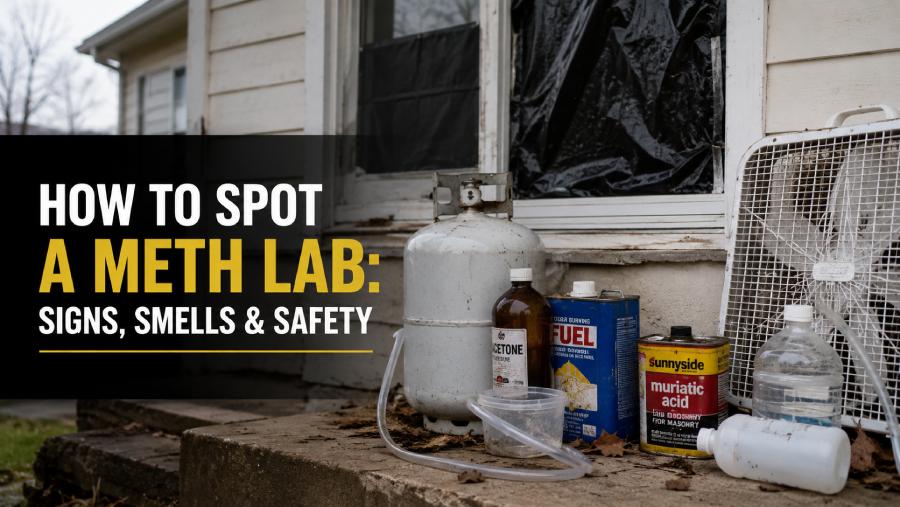
Before you ever smell anything unusual, visual cues can signal that a property warrants a closer look. These signs alone are not proof of drug manufacturing, but when several appear together, they form a pattern worth reporting.
- Windows covered with black plastic, foil, or blankets, even during daytime hours
- Unusual amounts of trash, particularly empty cold medicine packages, lithium batteries, and plastic bottles with tubes attached
- Chemical containers like acetone, muriatic acid, or drain cleaner piling up outside a residence
- Strong ventilation setups, such as fans running constantly or exhaust hoses leading out of windows
- Occupants who rarely appear in daylight and who discourage visitors or deliveries
- Staining or discoloration on outdoor surfaces, driveways, or soil from chemical dumping
- Burn pits or buried containers near the property
Landlords and property managers sometimes discover former meth labs only after tenants have moved out. Walls may show yellowish or brownish residue. Carpets absorb chemical vapors over time. Even a property that looks clean on the surface can carry toxic contamination at levels that cause health problems for the next occupants.
The Chemical Odors That Betray a Lab
Smell is often the first real alert that something is wrong. Meth synthesis relies on a rotating cast of volatile chemicals, and their combined odor is genuinely distinctive. People often describe it as a sharp, industrial smell that does not belong in a home environment. Some compare it to nail polish remover, cat urine, or a combination of solvents and something almost sweet underneath.
If you want a more detailed breakdown, a thorough resource on what a meth lab actually smells like can help you understand which specific chemicals produce which odors, and why the scent shifts depending on the stage of production happening at any given moment.
A few chemical smells are especially common around active labs. Anhydrous ammonia smells strongly of fertilizer or cat urine. Ether has a sweet, slightly medicinal quality. Acetone smells like nail polish remover. Phosphine, a byproduct of red phosphorus methods, carries a rotting fish or garlic-like odor and is acutely toxic. None of these smells belong near a residence without a clear, legitimate explanation.
| Chemical | Common Odor Description | Found In |
| Anhydrous ammonia | Cat urine, strong fertilizer | Refrigerant tanks, farm supply stores |
| Acetone | Nail polish remover | Hardware and beauty supply stores |
| Ether / diethyl ether | Sweet, medicinal | Engine starting fluid |
| Muriatic (hydrochloric) acid | Sharp, suffocating | Pool supply and hardware stores |
| Phosphine gas | Rotten fish, garlic | Byproduct of red phosphorus method |
| Lithium metal in solution | Metallic, acrid | Extracted from lithium batteries |
Health Risks for Neighbors and First Responders
Living near an active meth lab is not simply unpleasant. It is a genuine health hazard. Volatile chemicals can migrate through walls, ventilation systems, and soil. Children who play on contaminated ground or in contaminated buildings can absorb toxic residues through their skin. Adults who spend extended time in affected spaces report headaches, nausea, respiratory irritation, and neurological symptoms.
First responders face acute risks. Meth production involves flammable solvents and reactive chemicals that can ignite or explode if disturbed. The National Institute on Drug Abuse notes that roughly 15 percent of meth lab incidents reported to law enforcement involve fires or explosions. Phosphine gas, produced during some manufacturing methods, can be lethal at relatively low concentrations.
Even after a lab is dismantled, the building itself may remain hazardous. The EPA has published guidelines on meth lab cleanup precisely because standard cleaning methods do not remove chemical contamination from porous surfaces. Professional remediation, which can cost tens of thousands of dollars, is often required before a property is safe for habitation again.
What To Do If You Suspect a Nearby Meth Lab
The single most important rule is this: do not try to investigate on your own. Meth manufacturers are aware that discovery means serious criminal consequences, and many operations are protected by surveillance, guard animals, or armed occupants. The chemical hazards alone make unauthorized entry genuinely dangerous.
- Leave the area calmly if you believe you are currently being exposed to chemical fumes.
- Do not touch, move, or smell any containers or equipment you think may be associated with drug production.
- Call 911 if you believe there is an immediate threat to safety, such as a fire, explosion, or weapons.
- Contact your local law enforcement non-emergency line or the DEA tip line at 1-800-882-9539 for non-urgent suspicions.
- Provide specific details: the address, what you observed or smelled, when you noticed it, and how often activity occurs.
- Keep your report confidential and do not confront or alert the suspected operators.
Tenant protections vary by state, but many jurisdictions require landlords to disclose prior meth lab contamination. If you are renting or purchasing a property and have concerns, you can request disclosure documents or hire an independent inspector who can test for chemical residues. Several states, including Tennessee, maintain registries of properties that have been identified as former lab sites.
The Broader Context: Meth, Addiction, and Community Impact
Understanding the signs of a meth lab is about more than neighborhood safety. Methamphetamine addiction is one of the most difficult substance use disorders to treat, and production sites are both a symptom and a driver of that crisis. Communities that see significant meth lab activity tend to also experience higher rates of child neglect, property crime, and emergency room visits tied to drug use.
Recognizing where meth is being made does not solve addiction. But disrupting production removes a local supply source, which can create an opening for people caught in the cycle of use to seek help. Treatment for stimulant use disorder has advanced considerably, and recovery is achievable with the right support.
Awareness is a form of action. When neighbors, landlords, teachers, and community members know what to look for and how to report it safely, law enforcement can act faster and with better information. That combination of community knowledge and professional response is one of the most practical tools available for reducing the local harm caused by clandestine drug manufacturing.