

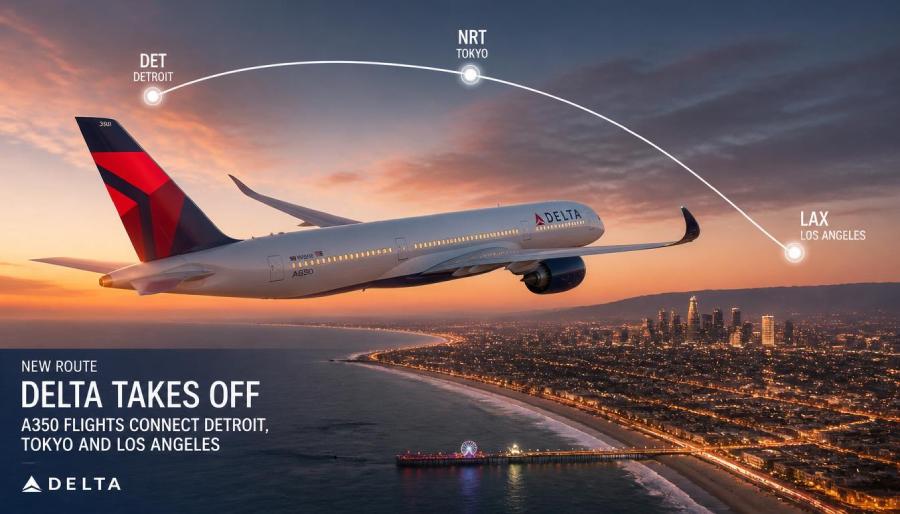
If you’ve spent any time online lately searching for “Delta Flight DL275 diverted LAX,” you’ve probably noticed two things: a lot of headlines, and not a lot of agreement between them. A long-haul flight bound for Tokyo unexpectedly putting down in Los Angeles is the kind of story that travels fast, and stories that travel fast tend to pick up a few extra passengers along the way. So let’s slow it down. As someone who pays close attention to how the airline industry actually operates, I want to walk you through what we can reasonably say about this event, what the aircraft and the route tell us, and why a diversion like this is usually a sign of the system working rather than failing.
The Short Version of the DL275 Story
Here’s the cleanest summary I can give you without overstating anything. Delta Flight DL275 is a scheduled Delta Air Lines service operating between Detroit Metropolitan Wayne County Airport and Tokyo’s Haneda Airport, typically flown with a widebody Airbus A350-900. At some point during one of these crossings, the flight broke from its planned routing and diverted to Los Angeles International Airport instead of continuing across the Pacific. The most commonly reported reason involves a problem with one of the engine’s anti-ice systems, and the aircraft is said to have landed safely with no injuries. That’s the part of the story I’m comfortable standing behind. The exact date, the precise technical trigger, and the passenger count are where the online accounts start to drift apart, and I’ll be honest with you about that further down rather than pretending there’s a tidy official record when there isn’t.
Detroit to Tokyo Is Not an Ordinary Flight
To understand why this diversion matters, you have to appreciate the route itself. Detroit is one of Delta Air Lines’ major hubs and a key gateway to Asia, funneling travelers from across the American Midwest onto long-haul services toward Japan and beyond. A flight from Detroit to Haneda is a serious undertaking, covering thousands of miles and routing far up toward the northern latitudes, near Alaska and across some of the most remote airspace in the world. Out there, your options for a quick landing are limited. There simply aren’t dozens of major international airports scattered across the North Pacific waiting to receive a widebody jet. That geography is exactly why crews and dispatchers plan these flights with such care, mapping out suitable diversion airports long before the wheels ever leave the ground. When people express surprise that a Tokyo-bound aircraft “ended up” in Los Angeles, the truth is that nothing about it was random.
Meet the Airbus A350, the Star of This Story
The aircraft at the center of the DL275 conversation is the Airbus A350-900, and it deserves a proper introduction because it shapes how this whole event unfolded. The A350 is a modern, twin-engine, widebody jet built specifically for long, demanding routes, and Delta operates a healthy fleet of them on its international network. It’s known for being quiet, fuel-efficient, and packed with the kind of digital monitoring systems that earlier generations of aircraft could only dream of. Those Rolls-Royce Trent XWB engines and their surrounding systems are watched constantly by onboard computers that flag anomalies the moment they appear, often well before anything becomes a genuine hazard. So when you hear that an A350 diverted because of a system alert, the more accurate way to read it is that the aircraft did precisely what it was designed to do: notice a developing issue early and give the crew plenty of room to make a calm, deliberate decision.
What an Engine Anti-Ice System Actually Does
Since the engine anti-ice system keeps coming up in connection with Delta Flight DL275, it’s worth explaining what that piece of equipment is, because the name sounds more dramatic than the reality. At cruising altitude, the air outside an aircraft is brutally cold, often dozens of degrees below freezing even on a warm summer day at the surface. When that frigid air carries moisture, ice can begin to form on sensitive surfaces, including parts of the engine inlet. To prevent that, modern jets route hot air bled from the engine to keep those critical areas warm and clear. An anti-ice system is essentially a protective heater for the engine, and if a sensor suggests it isn’t behaving the way it should, the smart move is to address it promptly rather than gamble on it across hours of remote ocean. A fault in this system doesn’t mean an engine is about to quit; it means a safeguard might not be fully reliable, and crews treat their safeguards seriously.
Why a Tokyo-Bound Flight Landed in Los Angeles
This is the question that sends people to their search bars in the first place: if the plane was going to Japan, why turn toward California? The answer comes down to a calculation that pilots and dispatchers run almost reflexively. Choosing a diversion airport is never about picking the closest dot on a map; it’s about finding the airport that best combines a long enough runway, the ability to handle a heavy widebody, strong weather, available maintenance support, and the resources to take care of a few hundred displaced passengers. For a flight in the western portion of its journey, Los Angeles International Airport checks every one of those boxes. As one of the busiest international gateways in the United States and a place thoroughly equipped to receive and service large aircraft, LAX is close to an ideal destination for an unplanned landing. The LAX diversion, far from being strange, reflects exactly the kind of practical reasoning that defines good flight operations.
The Decision-Making Behind Any Diversion
People sometimes imagine a diversion as a frantic, split-second scramble in the cockpit, but the reality is usually the opposite. When a system alert appears, a professional flight crew works through established checklists, consults with their airline’s operations and dispatch teams on the ground, and weighs the options methodically. They consider how much fuel they have, what airports lie within comfortable reach, what the weather looks like at each, and what kind of support they’ll find on arrival. Only after that assessment do they commit to a plan. The decision to redirect Delta Flight DL275 toward LAX, assuming the reporting is broadly accurate, would have followed this same disciplined process. It’s a coordinated effort between the people in the air and the people on the ground, and it’s built around a simple principle: when there’s any doubt about continuing a long overwater leg, you choose the option that preserves the widest possible safety margin.
A Word of Caution: Sorting the Facts From the Noise
Here’s where I’m going to level with you, because pretending otherwise wouldn’t be fair. The information circulating about this specific incident is genuinely messy. Different write-ups give different dates, with some pointing to spring of 2025 and others suggesting it happened much more recently. The stated cause shifts too, depending on which page you land on. Most mention the engine anti-ice system, but others toss in a medical emergency or even a suspected cabin pressurization issue, and a few sprinkle in oddly specific passenger counts and quotes that don’t trace back to any official source. I haven’t been able to find confirmation from Delta Air Lines, the FAA, or a recognized aviation incident database that pins down the precise details. So treat the granular specifics with healthy skepticism. The broad shape of the story — an A350 on the Detroit-Tokyo run diverting to LAX after a technical concern — is plausible and widely repeated, but the fine print deserves a raised eyebrow until a credible primary source backs it up. Real expertise isn’t just knowing things; it’s knowing where the solid ground ends.
What Passengers Likely Experienced Onboard
Even with the uncertainty around the details, we can talk sensibly about what a diversion like this feels like from seat 34K. The first sign is usually a change you can feel before anyone explains it, perhaps a gentle turn or a shift in the engine note, followed by an announcement from the flight deck. Good crews aim to be clear and calm, telling passengers that the aircraft is being redirected as a precaution and that there’s no cause for alarm. Cabin crew then move into a familiar rhythm, reassuring travelers, answering questions, and preparing the cabin for an earlier-than-expected landing. For passengers, the dominant emotions are typically inconvenience and uncertainty rather than fear, especially once it becomes clear the aircraft is operating normally. Long-haul diversions also tend to mean long days, with hours spent sorting out connections, hotels, and rebookings once everyone is safely on the ground.
How Delta and Its Crews Handle the Aftermath
A diversion doesn’t end when the wheels touch down; in many ways, that’s when a whole second operation begins. Once an aircraft like the one on Delta Flight DL275 is parked at a diversion airport, the airline’s teams shift into recovery mode. Maintenance technicians inspect and, if needed, repair the flagged system, while customer service staff work to rebook missed connections, arrange accommodations, and get passengers moving toward their final destinations. Crews are also bound by strict duty-time limits, which means the original team may “time out” and require replacements before the journey can resume, adding to the delay. None of this is glamorous, and it’s expensive and logistically painful for an airline, but it’s also a sign of a system that prioritizes doing things properly over doing them quickly. Delta Air Lines, like any major international carrier, has well-rehearsed playbooks for exactly these situations.
What This Means for Delta Air Lines Operationally
From the airline’s perspective, an event like the DL275 diversion is both a headache and a quiet vindication. The headache is obvious: a disrupted schedule, an aircraft and crew out of position, compensation and accommodation costs, and a wave of online attention that’s rarely flattering. The vindication is subtler. A diversion that ends with everyone safely on the ground demonstrates that the layers of protection — the onboard monitoring, the trained crew, the dispatch support, the maintenance network — all functioned as intended. Incidents like this also feed into something the industry increasingly cares about: predictive maintenance, where data gathered from real-world events helps airlines anticipate and replace components before they ever cause a problem in flight. For a carrier the size of Delta Air Lines, every diversion is a data point that can make the next ten thousand flights a little smoother.
Is Flying Still Safe? Putting Diversions in Perspective
It’s worth zooming out, because a single dramatic-sounding headline can distort how we think about risk. Flight diversions happen far more often than most travelers realize, driven by everything from weather and medical situations to the kind of technical caution we’re discussing here. The vast majority resolve without injury, precisely because the entire framework of commercial aviation is engineered around redundancy and conservative decision-making. Aviation safety isn’t a single feature; it’s a culture, one where crews are trained and even rewarded for erring toward caution rather than pressing on to stay on schedule. When you understand that, the DL275 story reads very differently. It stops looking like a brush with disaster and starts looking like an ordinary safeguard doing its job. The mark of a healthy safety system is not that nothing ever goes wrong, but that when something does, it’s caught early and handled calmly.
What You Should Do If Your Flight Ever Diverts
Since most of us will eventually experience a diversion or significant delay, a little preparation goes a long way. Listen carefully to the crew and follow their instructions without adding to the stress of the moment, because they’re managing the cabin as well as the situation. Keep your phone charged so you can rebook and contact people once you land, and hold on to your boarding pass and any documentation, which can help with rebooking and potential compensation. Familiarize yourself with your airline’s policies on diversions and delays before you travel, and consider travel insurance for long international trips. Most importantly, try to reframe the experience in your own head. A diversion is inconvenient, sometimes deeply so, but it is fundamentally a decision made to protect you. Staying calm and cooperative makes the whole process faster and easier for everyone, yourself included.
FAQs
Why was Delta flight DL275 diverted to LAX?
According to the most widely circulated reports, the diversion was prompted by a suspected fault in one of the engine’s anti-ice systems. The crew chose to land at LAX as a precaution rather than continue the long overwater stretch toward Tokyo, though the exact technical cause hasn’t been confirmed by an official source.
Was anyone hurt when DL275 diverted?
No injuries have been reported in connection with the diversion. Every account agrees the Airbus A350 landed safely at Los Angeles, which is the typical outcome of a precautionary diversion.
What aircraft operates Delta flight DL275?
The route is normally flown with a widebody Airbus A350-900, a modern twin-engine jet built for long-haul international flying and equipped with extensive onboard monitoring systems that flag issues early.
Where does Delta flight DL275 normally fly?
DL275 is a scheduled Delta Air Lines service between Detroit Metropolitan Wayne County Airport and Tokyo’s Haneda Airport, one of the carrier’s key gateways connecting the U.S. Midwest to Asia.
Are flight diversions like DL275’s dangerous?
Generally, no. Diversions are far more common than most travelers realize and are usually a sign of the safety system working as intended, with crews trained to err on the side of caution well before a situation becomes hazardous.
Conclusion
The “Delta Flight DL275 diverted LAX” story is a useful little case study in how to read aviation news without getting swept up in it. Strip away the conflicting dates and the unverified embellishments, and what remains is a recognizable and reassuring pattern: a modern Airbus A350 operating a demanding Detroit-to-Tokyo route encountered a technical concern, most often described as an engine anti-ice issue, and the crew made the measured choice to divert to LAX, a major airport perfectly suited to handle it. No injuries, a safe landing, and a lot of behind-the-scenes work to get everyone on their way. I’d still encourage you to be cautious about the specific details until a credible primary source confirms them, but the broad lesson holds regardless. The LAX diversion is not a story about aviation failing; it’s a story about aviation safety, the people who practice it, and the deep culture of caution that quietly protects millions of Delta Air Lines passengers every single day. The next time a flight of yours takes an unexpected turn, you’ll know there’s a thoughtful process behind it rather than a panic.