

Roman Nose is a term that has fascinated people for centuries because it describes one of the most recognizable facial features in human anatomy. A prominent bridge, a slightly curved profile, and a strong side view often make this nose shape easy to identify. While it has been admired in art, discussed in history, and analyzed in modern beauty conversations, there is still plenty of confusion surrounding what a Roman nose actually is.
Many people assume that having a Roman nose automatically means someone has Roman ancestry or belongs to a specific ethnic group. Others believe it reveals certain personality traits or even predicts leadership qualities. In reality, these ideas are largely based on historical beliefs, artistic traditions, and cultural stereotypes rather than scientific evidence.
Understanding the Roman nose requires looking beyond appearance alone. Human facial features develop through a combination of genetics, environmental influences, and natural biological variation. Every nose shape serves the same essential functions of breathing, smelling, filtering air, and supporting facial structure, regardless of how prominent or subtle it appears.
What Is a Roman Nose?
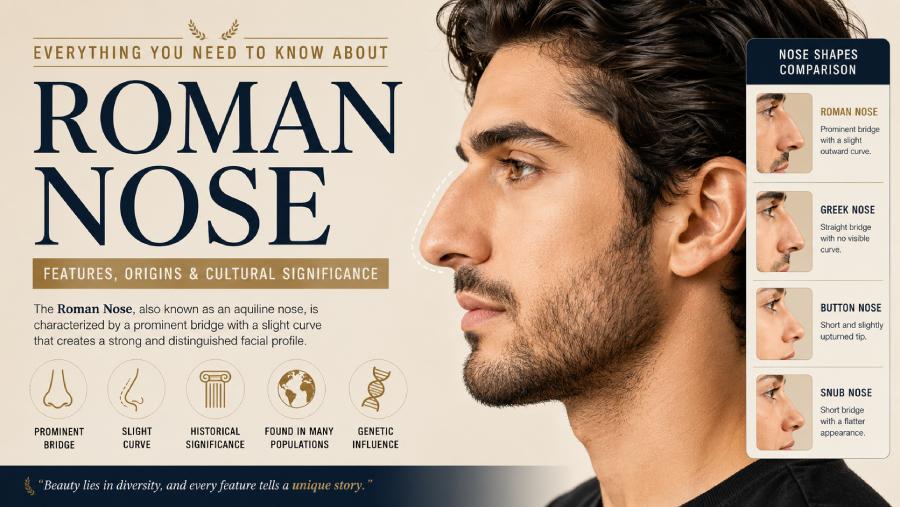
A Roman nose, often referred to as an aquiline nose, is characterized by a high and prominent nasal bridge that may curve slightly outward before reaching the tip. Unlike perfectly straight nose shapes, the Roman nose typically creates a distinguished profile when viewed from the side. The bridge can be gently arched or feature a noticeable hump, while the tip generally points forward or slightly downward. The degree of curvature varies considerably from person to person, making every Roman nose unique. Some individuals have only a subtle elevation along the bridge, while others display a more pronounced contour that becomes a defining facial feature.
Key Physical Characteristics of a Roman Nose
Recognizing a Roman nose involves examining several anatomical features together rather than focusing on a single detail. The bridge is usually the most prominent characteristic, standing higher than average and creating a bold facial outline. Many Roman noses feature a smooth convex curve rather than a perfectly straight bridge. The nasal tip may remain relatively refined, although some people have a broader or slightly downward-pointing tip that complements the bridge. In profile, the nose often appears longer and more structured than flatter nose types. These features combine to create a facial appearance that many artists and sculptors have admired for centuries.
Why Is It Called a Roman Nose?
The name originated because many ancient Roman sculptures, coins, and statues portrayed influential figures with strong, prominent noses. Over time, this facial profile became associated with Roman leadership, military power, and noble status. It is important to understand that the name describes an appearance rather than a guaranteed connection to Roman ancestry. Ancient artists frequently idealized facial features to emphasize authority and strength, meaning many sculptures reflected artistic choices instead of exact physical likenesses. As a result, the term “Roman nose” eventually became a descriptive label for a particular nose shape rather than an indicator of heritage.
The Difference Between a Roman Nose and Other Nose Shapes
Human noses display remarkable diversity, and distinguishing one type from another helps eliminate common misunderstandings. A Roman nose differs from a Greek nose because the Greek nose usually has a completely straight bridge without a noticeable curve. A button nose is much shorter, with a rounded and slightly upturned tip, while a snub nose tends to have a flatter bridge. A hawk nose may resemble a Roman nose but often features a sharper downward curve. Meanwhile, a fleshy nose appears wider and softer due to thicker tissue. These distinctions highlight that nose shapes exist on a broad spectrum rather than fitting into rigid categories.
Genetics and the Development of a Roman Nose
Genetics play the largest role in determining nose shape. Multiple genes influence bone structure, cartilage development, skin thickness, and facial proportions. Rather than being controlled by a single inherited trait, a Roman nose develops through the interaction of many genetic factors passed down across generations. It is entirely possible for parents with relatively subtle noses to have a child with a more prominent bridge if inherited genetic combinations produce that result. Environmental influences during growth may also contribute to minor differences, but hereditary factors remain the primary reason why nose shapes vary so widely among individuals.
Is a Roman Nose Linked to a Particular Ethnicity?
One of the biggest misconceptions is that Roman noses belong exclusively to people of Italian or Roman descent. In reality, this nose shape appears across numerous populations throughout Europe, the Middle East, North Africa, South Asia, and many other regions of the world. Human migration over thousands of years has distributed countless genetic traits across continents. Consequently, someone with a Roman nose may have completely different ancestry from another individual who shares the same facial feature. Modern genetics demonstrates that physical characteristics alone cannot accurately determine a person’s ethnic background.
Common Myths About the Roman Nose
Throughout history, many myths have surrounded the Roman nose. Some traditions claimed that individuals with this feature were naturally more courageous, intelligent, determined, or destined for leadership. Others believed it indicated nobility or superior character. While these ideas became popular through literature, folklore, and historical art, scientific research has found no evidence connecting nose shape with personality, intelligence, or moral qualities. Human behavior results from a complex combination of genetics, upbringing, education, environment, and personal experiences rather than facial anatomy. Appreciating the Roman nose as a physical feature without attaching stereotypes leads to a far more accurate understanding.
Roman Nose in History and Classical Art
Artists throughout history have frequently highlighted strong nasal profiles when depicting emperors, generals, philosophers, and influential public figures. During ancient Rome and later Renaissance periods, sculptors often emphasized prominent facial structures to symbolize confidence, discipline, and authority. These artistic conventions significantly influenced public perception of beauty and power. Although not every historical Roman actually possessed this nose shape, the repeated representation of strong bridges in statues helped establish the Roman nose as an enduring cultural symbol. Even today, museums around the world display sculptures that continue reinforcing this classical aesthetic.
The Roman Nose in Modern Beauty Standards
Beauty standards constantly evolve, and the Roman nose has experienced changing levels of popularity over time. While certain cosmetic trends have favored smaller, straighter noses, many people today celebrate distinctive facial features that create individuality and character. Fashion photography, cinema, and modeling increasingly embrace diverse facial structures instead of promoting a single ideal appearance. Numerous actors, models, and public figures have chosen to keep their naturally prominent noses, demonstrating that confidence often contributes more to attractiveness than strict conformity to beauty trends. This shift reflects a growing appreciation for authentic human diversity.
Functional Differences: Does a Roman Nose Affect Breathing?
From a medical perspective, a Roman nose generally functions just like any other healthy nose. The external shape does not automatically determine breathing ability, airflow, or sense of smell. However, some individuals with prominent bridges may also have internal structural differences, such as a deviated septum or enlarged nasal tissues, that can affect breathing. These conditions are separate medical issues and are not caused simply by having a Roman nose. An evaluation by an ear, nose, and throat specialist is necessary if breathing problems develop.
Cosmetic Procedures for a Roman Nose
Some individuals choose cosmetic procedures to alter the appearance of a Roman nose, particularly if they wish to reduce a noticeable hump or create a straighter bridge. Rhinoplasty remains the most common surgical option for reshaping the nose while maintaining facial balance. Advances in surgical techniques allow experienced surgeons to preserve natural-looking proportions rather than producing identical results for every patient. In some cases, non-surgical fillers can temporarily smooth minor contour irregularities. Anyone considering cosmetic treatment should prioritize realistic expectations, thorough consultation, and an experienced medical professional who understands facial harmony.
Learning to Appreciate Natural Facial Features
Modern conversations about self-image increasingly encourage people to embrace unique facial characteristics rather than viewing them as flaws. A Roman nose often contributes significantly to facial identity and individuality. Many people discover that what they once considered an imperfection actually becomes one of their most memorable features. Confidence, healthy skin, good posture, and genuine expression usually have a greater impact on overall appearance than altering naturally inherited anatomy. Appreciating natural diversity promotes healthier self-esteem while recognizing that beauty exists in countless forms.
Caring for Your Nose and Overall Nasal Health
Although nose shape itself requires no special maintenance, proper nasal care supports overall health regardless of facial structure. Staying hydrated helps keep nasal tissues comfortable, while maintaining indoor humidity during dry seasons reduces irritation. Avoiding smoking and limiting exposure to pollutants protects sensitive nasal passages. Individuals with allergies benefit from appropriate treatment to minimize chronic inflammation. Wearing protective equipment during sports can also reduce the risk of injury to the delicate bones and cartilage that form the nose. Good health habits contribute far more to nasal function than external appearance.
Roman Nose in Popular Culture and Media
Popular culture has portrayed Roman noses in many different ways across films, literature, fashion, and advertising. In earlier decades, prominent noses were sometimes minimized through makeup, camera angles, or cosmetic surgery due to changing beauty ideals. More recently, audiences have embraced authenticity, encouraging celebrities and public figures to retain their distinctive features. This broader representation helps challenge outdated stereotypes while demonstrating that facial uniqueness can become a defining element of personal style. Increased diversity in media also encourages younger generations to develop healthier attitudes toward natural appearance.
FAQs
Is a Roman nose considered attractive?
Yes. Attractiveness is subjective, and many people find the strong profile of a Roman nose distinctive, elegant, and memorable.
Can someone inherit a Roman nose if neither parent has one?
Yes. Multiple genes influence nose shape, so inherited genetic combinations can produce features that are not obvious in either parent.
Does a Roman nose affect breathing?
Not necessarily. Most Roman noses function normally unless an unrelated internal nasal condition affects airflow.
Can exercise change the shape of a Roman nose?
No. Exercise strengthens muscles and improves overall health, but it cannot reshape the bones or cartilage of the nose.
Is rhinoplasty the only permanent way to change a Roman nose?
Yes. Surgical rhinoplasty is currently the only permanent method for significantly changing the external shape of the nose.
Conclusion
The Roman nose remains one of the most recognizable and historically significant facial features found across human populations. Its prominent bridge, distinctive profile, and long association with classical art have made it an enduring subject of fascination for historians, artists, medical professionals, and the general public alike. Despite centuries of myths connecting this nose shape to personality, ancestry, or social status, modern science shows that it is simply one of many normal variations of human anatomy.