

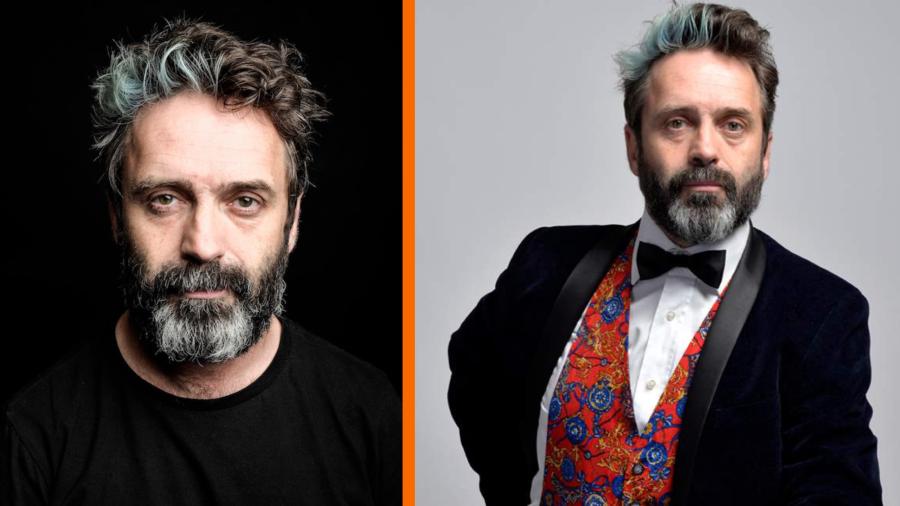
Phil Nichol is one of those rare performers who genuinely cannot be boxed in. Comedian, singer-songwriter, actor, writer, director, theatre company founder — the man has done it all, and somehow done it well. Born in Glasgow, Scotland, and raised in Toronto, Canada, Phil has carved out a career that spans decades, continents, and creative disciplines. He is the kind of artist who makes you wonder why more people aren’t talking about him. The short answer? He’s been too busy performing in 52 countries to wait for the hype to catch up.
From Glasgow to Toronto: The Making of a Comic Mind
Phil Nichol was not born into comedy — he was shaped into it by an unlikely mix of influences. His parents, devout born-again Christians who had emigrated from Scotland to Canada, were not exactly the types to encourage a career in entertainment. Theatre school was a tough sell at home, but a performance of Shakespeare’s The Tempest at age 12 planted a seed that refused to stop growing. By 17, Phil had taught himself to play guitar, immersed himself in the Toronto improv scene, and secured a four-year place at the School of Dramatic Art at the University of Windsor, Ontario.
What’s worth noting here is the environment that shaped his sense of humour. Growing up in a religiously conservative household while simultaneously gravitating toward the chaotic, irreverent world of improv comedy created a natural tension — and as any seasoned comedian will tell you, tension is exactly where the best material lives. His mother, whom Phil has described as a source of warmth and laughter, is credited as a key inspiration for his pursuit of comedy. That contradiction between his upbringing and his creative instincts never really went away, and it became the foundation for some of his most personal and acclaimed work later in his career.
Corky and the Juice Pigs: Where It All Began
At the University of Windsor, Phil met fellow student Sean Cullen, and the two went on to co-found one of Canada’s most beloved comedy acts — Corky and the Juice Pigs. The trio, rounded out by Greg Neale, launched in March 1987 and quickly developed a reputation as a high-energy, guitar-driven comedy force. They were the kind of act that made audiences feel like they were watching something that could fly off the rails at any moment — in the best possible way.
The Juice Pigs were known for sharp, absurdist musical comedy, and their song “The Only Gay Eskimo” became something of a cult classic. The group received a Perrier Award nomination at the Edinburgh Festival Fringe in 1993 — Phil’s first brush with the UK’s most respected comedy accolade. At their peak, they appeared on MADtv on Fox for a season and a half, bringing their distinctly Canadian flavour of chaos to American audiences. For Phil, this was more than just fun — it was a decade-long masterclass in timing, audience connection, and the craft of comedy songwriting. He soaked it all in.
By 1996, the group had run its course. Phil left and set his sights on London, where he would begin the solo chapter of his career.
Going Solo: Building a Career One Edinburgh Show at a Time
Moving to London in 1998 without the safety net of an established act takes a certain kind of confidence — or stubbornness. In Phil’s case, it was probably both. His early solo gigs were, by his own candid admission, rough. He was running on energy and instinct rather than material, and it showed. But rather than retreating, he kept going, kept refining, and kept showing up at clubs until he figured it out.
That persistence paid off quickly. In 1998, he won the prestigious Time Out Comedy Award, signalling to the UK comedy world that this Canadian transplant was the real deal. He went on to perform at the Edinburgh Festival Fringe almost every single year, eventually writing 23 sold-out hour-long shows for the festival. That is not a typo — 23 shows. For context, most comedians are thrilled to produce a handful of strong Edinburgh hours in a career. Phil turned it into an annual tradition.
His 2002 Edinburgh show, Things I Like I Lick, earned him his second Perrier Award nomination, cementing his reputation as a serious voice in the festival circuit. But his biggest moment was still to come.
The Naked Racist: An Award-Winning Moment of Brave Comedy
If there is one show that defines Phil Nichol’s standing in the comedy world, it is The Naked Racist. The show emerged from an unlikely place — an onstage confrontation with comedian Scott Capurro and an accusation of homophobia. Rather than deflecting or ignoring it, Phil turned the experience into material, launching what became a trilogy of confessional storytelling shows: Nearly Gay, The Naked Racist, and Hiro Worship, performed between 2005 and 2007.
The Naked Racist won the Edinburgh Comedy Award in 2006 — formerly known as the Perrier Award, and widely regarded as the most coveted prize in British stand-up. Phil performed the show at The Stand in Edinburgh before taking it to the Melbourne International Comedy Festival, where it was equally well received. This was not shock comedy for the sake of it. The show was smart, self-examining, and honest in ways that most performers would find uncomfortable to even approach. It demonstrated that Phil Nichol was willing to go places that other comedians simply were not.
The Nearly Gay show, performed at the Edinburgh Fringe in 2005, explored Phil’s experience as a straight man with a predominantly gay social circle, and attracted strong reviews from mainstream media. It was the kind of subject matter that required both delicacy and boldness — two qualities Phil has always had in abundance.
Phil Nichol as an Actor: From the West End to the BBC
Phil Nichol’s acting career is the part of his story that often surprises people who know him primarily as a stand-up. His stage work in particular has been nothing short of impressive. One of his earliest major acting roles was as Philip Salon in Taboo, Boy George’s autobiographical musical that premiered in London’s West End in 2002. It was a production that generated enormous attention, and Phil held his own in a cast that was performing a story as flamboyant and theatrical as the life it depicted.
From there, his acting credits grew steadily. On television, Phil played Terry Gilliam in the BBC’s BAFTA-nominated Holy Flying Circus, a fictionalised account of Monty Python’s battles over Life of Brian. He appeared as Mark in Sharon Horgan and Rob Delaney’s Channel 4 hit Catastrophe, as Jerry in the award-winning BBC3 sitcom Uncle, and as the pagan pub landlord Paul Chambers in Agatha Raisin for Acorn and Sky Max. He also appeared as a drag queen in the Olivier Award-nominated musical Everybody’s Talking About Jamie, and performed in One Flew Over the Cuckoo’s Nest alongside Christian Slater.
His performance in The Zoo Story at the Edinburgh Festival in 2005 earned him the Stage Award for Acting Excellence, and in 2011, his monologue Somewhere Beneath It All, A Small Fire Burns Still won a Scotsman Fringe First award. These are not the achievements of someone dabbling in acting on the side. Phil Nichol is a genuinely accomplished stage and screen performer.
The Comedians Theatre Company: Building Something That Lasts
One of the most underappreciated aspects of Phil Nichol’s career is his work as a producer and director. In the mid-2000s, he co-founded the Comedians Theatre Company, which he continues to lead as Artistic Director. Now in its 19th year, the company has produced more than 30 productions and even a radio series for BBC Radio 4.
The company exists at the intersection of comedy and serious theatrical work — a space Phil has always felt most at home in. It gives comedians the chance to stretch beyond the confines of the stand-up circuit and explore storytelling in a more structured dramatic context. It is the kind of institution-building that most performers never bother with, and it speaks to Phil’s genuine commitment to the art form rather than just his own career.
Music: A Thread That Has Never Been Cut
Comedy and music have always been intertwined in Phil Nichol’s world. From his Juice Pigs days through to his solo work, music has been a constant. In 2014, he released Late Night Electric Watermelon, his first album of comedic songs since the Juice Pigs era. His solo album Ethel’s Little Ditties followed in 2016. He is also the lead singer and primary songwriter of Muscle, a rock parody band that leans hard into the absurdity of the genre.
His full catalogue is now available as Phil Nichol’s Comedy Body, a 14-piece digital collection on Bandcamp that includes 12 original comedy and music albums alongside two bonus releases. It is an extraordinary archive of a career that has never stopped evolving. For fans who discovered Phil through his stand-up, diving into his music is a genuinely rewarding experience — and for music fans who stumble across it, it is a revelation.
A Global Career: 52 Countries and Counting
The numbers attached to Phil Nichol’s touring career are staggering. He has performed in 52 countries and has run Edinburgh shows almost every year since the early 1990s. His most recent international touring show, Your Wrong, played more than 130 dates across 13 countries. He has appeared at the Just for Laughs Festival, the Melbourne International Comedy Festival, the New Zealand Comedy Festival, and the Edinburgh Fringe Festival, among many others.
He has also recorded five stand-up comedy specials, appeared on The Graham Norton Show, Never Mind the Buzzcocks, The Weakest Link (memorably walking off the set naked after elimination), and dozens of other television programmes across multiple countries. On stage, he performed with the Donmar Warehouse in New York in The Machine, written by Academy Award-nominated playwright Matt Charman. For a man who spent his early solo gigs dying on stage, the trajectory has been nothing short of remarkable.
What Makes Phil Nichol Tick as a Performer
There is a quality to Phil Nichol’s performance style that is hard to pin down but immediately recognisable. He is described consistently as “manically exuberant” — a performer whose energy fills a room before he has said a single word. But what separates him from a dozen other high-energy comics is the intelligence underneath the chaos. His best work is not just loud or fast — it is layered, self-aware, and structurally sharp.
He has a gift for improvisation, both musically and comedically, that allows him to adapt to any audience or situation without losing the thread of what he is doing. His willingness to engage with uncomfortable personal material — whether that is his upbringing, his identity, or his place in broader social conversations — gives his comedy a confessional quality that audiences find genuinely engaging. He does not hide behind the jokes. He uses them to say something true.
FAQs
Who is Phil Nichol?
Phil Nichol is a Canadian comedian, singer-songwriter, and actor who was born in Glasgow, Scotland, and raised in Toronto. He is best known for winning the Edinburgh Comedy Award in 2006 and for his decade-long tenure with the musical comedy trio Corky and the Juice Pigs.
What award did Phil Nichol win at the Edinburgh Festival?
Phil Nichol won the Edinburgh Comedy Award — formerly known as the Perrier Award — in 2006 for his show The Naked Racist. It is considered one of the most prestigious accolades in British stand-up comedy.
What is the Comedians Theatre Company?
The Comedians Theatre Company is an award-winning theatre company co-founded by Phil Nichol, which he continues to lead as Artistic Director. Now in its 19th year, it has produced over 30 theatrical productions and a BBC Radio 4 series.
What music has Phil Nichol released?
Phil has released 15 comedy and music albums across his career, all compiled in the Phil Nichol’s Comedy Body digital collection on Bandcamp. His solo work includes Late Night Electric Watermelon (2014) and Ethel’s Little Ditties (2016), and he fronts the rock parody band Muscle.
What TV shows has Phil Nichol appeared in?
Phil Nichol has appeared in a wide range of television programmes, including Catastrophe (Channel 4), Uncle (BBC3), Holy Flying Circus (BBC), Man Down (Channel 4), Agatha Raisin (Sky Max), Never Mind the Buzzcocks, and The Graham Norton Show, among many others.
Conclusion
Phil Nichol is the kind of artist who defies easy description, and that is precisely what makes him interesting. Over the course of nearly four decades in entertainment, he has built a career that is genuinely his own — shaped by his Canadian roots, his Scottish origins, his unconventional upbringing, and his relentless creative drive. From the chaos of the Juice Pigs to the emotional honesty of The Naked Racist, from West End stages to BBC television, from comedy albums to theatre directing, Phil Nichol has never settled for doing just one thing.