

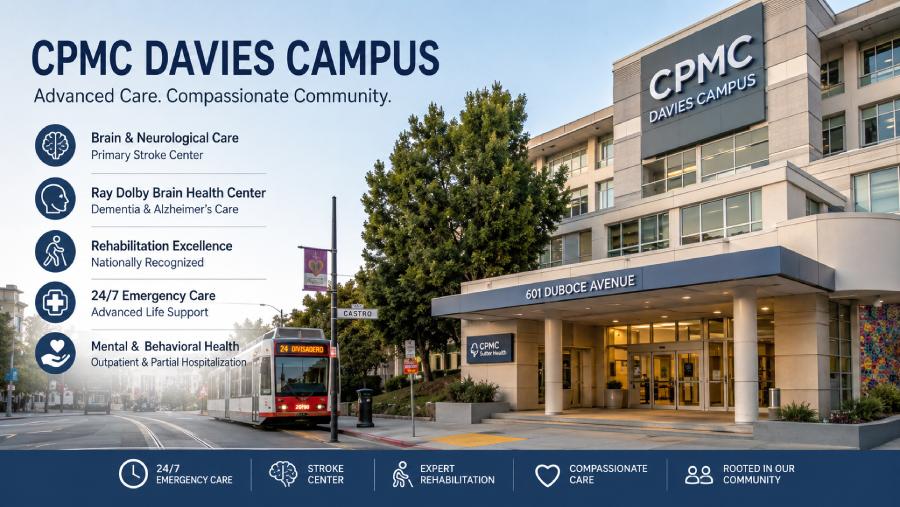
If you’ve spent any time in San Francisco’s Duboce Triangle, you’ve probably walked right past one of the city’s most capable hospitals without giving it a second thought. CPMC Davies Campus doesn’t shout for attention the way some big-name medical centers do. It sits tucked into a residential neighborhood, surrounded by Victorian flats and coffee shops, doing serious clinical work behind a fairly understated facade. But make no mistake, this place punches well above its weight, especially when it comes to brain health, stroke response, and getting people back on their feet after illness or surgery. Let’s take a proper walk through what makes this campus tick, who it serves, and why it has quietly earned a reputation that extends far beyond its neighborhood borders.
What and Where Davies Actually Is
CPMC Davies Campus is one of the acute care hospitals run by California Pacific Medical Center, which itself is part of the not-for-profit Sutter Health network. Geographically, it lives in the Duboce Triangle, right around the intersection of Castro Street and Duboce Avenue, with its formal address at 601 Duboce Avenue. That location is more meaningful than it sounds. The campus sits at the crossroads of several densely populated neighborhoods, which means it functions as a genuine community hospital for a huge slice of central San Francisco while simultaneously offering specialty care that draws patients from much farther afield. You get the best of both worlds here: a neighborhood feel paired with the kind of advanced clinical muscle you’d normally associate with a sprawling academic medical center. It’s the sort of hospital where a longtime resident might go for a routine lab test and also where someone in the middle of a medical emergency might have their life saved.
A Little History Behind the Name
The Davies name carries some local weight, and the campus has roots that stretch back well before the modern Sutter Health era. Like a lot of San Francisco’s medical institutions, it came together through a series of mergers and reorganizations that folded several of the city’s older hospitals into what we now know as California Pacific Medical Center. That history matters because it explains why Davies feels so embedded in the fabric of the city. This isn’t a hospital that got dropped into a fresh suburban development a few years ago. It carries decades of institutional memory, the kind of accumulated experience that shows up in how the staff handle complex cases and how deeply the place is woven into the lives of the families who’ve relied on it across generations. When people in this part of San Francisco say “Davies,” they usually mean it with a certain familiarity, the way you’d talk about a longtime neighbor rather than a faceless corporation.
The Emergency Department: Open Around the Clock
One of the campus’s anchors is its emergency department, which runs 24 hours a day, seven days a week. This is the front door for a lot of patients, and it’s staffed by teams specially trained in advanced life support and critical care. The ED handles the full spectrum of medical emergencies, from the genuinely life-threatening to the urgent-but-stable situations that fill any busy urban emergency room. What’s worth appreciating here is that an around-the-clock ED in a neighborhood like Duboce Triangle is genuinely valuable infrastructure. When something goes wrong at three in the morning, the difference between a hospital that’s twenty minutes away and one that’s an hour away can be enormous. The Davies emergency team also feeds directly into the campus’s specialty strengths, which means a patient arriving with stroke symptoms or a neurological crisis lands in a place that’s actually built to handle exactly that kind of problem. Of course, the standard advice always applies: if you’re facing a true life-threatening emergency, call 911 first rather than trying to drive yourself.
Stroke Care and the Primary Stroke Center Designation
Here’s where Davies really starts to distinguish itself. The campus is designated as a Primary Stroke Center, which is not a label hospitals get to slap on themselves casually. That designation signals that the facility meets specific standards for rapidly recognizing, diagnosing, and treating strokes, where every minute genuinely counts toward preserving brain function. Stroke care is a discipline obsessed with speed, because the longer brain tissue goes without proper blood flow, the more damage piles up. A Primary Stroke Center is built around protocols designed to compress the time between a patient walking through the door and receiving treatment. For a neighborhood hospital to carry this designation tells you something about the seriousness of the clinical operation here. Combined with the 24/7 emergency department, it means someone experiencing the early signs of a stroke in central San Francisco has a real shot at reaching expert care fast enough to make a meaningful difference in their recovery.
The Ray Dolby Brain Health Center
If there’s a crown jewel at Davies, the Ray Dolby Brain Health Center is a strong candidate for the title. This center focuses on specialized dementia and Alzheimer’s care, an area of medicine that is both increasingly important as the population ages and notoriously difficult to do well. The center provides care that goes beyond simply managing symptoms, offering patients access to clinical trials that connect them with emerging treatments and research. That last part is significant. Clinical trial access means patients here aren’t limited to the standard playbook; they can potentially benefit from approaches still being studied and refined. For families navigating a dementia or Alzheimer’s diagnosis, having a dedicated brain health center within the same campus that handles stroke and broader neurological care creates a kind of continuity that’s hard to find. You’re not bouncing between disconnected facilities. The expertise is concentrated in one place, and that concentration tends to produce better, more coordinated outcomes.
Rehabilitation and Getting People Home Again
Davies has long been known as a place where people go to recover, and its rehabilitation program is one of its defining features. The short-term rehabilitation services here recently earned national recognition, landing the campus on U.S. News & World Report’s list of Best Nursing Homes and Skilled Nursing facilities for 2026 with a High-Performance designation. That recognition centers on how the program helps patients regain mobility, strength, and independence after a hospitalization for illness, surgery, or injury. The approach blends personalized physical, occupational, and speech therapy with attentive nursing care, all built around the individual patient’s recovery goals. The whole point is to get people back to their normal lives safely, which means therapy plans aren’t one-size-fits-all. They’re tailored to whatever each person needs to transition back home with confidence. Recovery is rarely a straight line, and a good rehab program understands that, meeting patients where they are and adjusting as they progress. The national recognition is essentially outside validation of what the local community has known for a long time, that Davies is a place where recovery is taken seriously.
Surgical Services You Might Not Expect
For a campus this size, the surgical offerings are surprisingly advanced. Davies provides robotic-assisted joint replacements, neurosurgery, and plastic surgery, which collectively represent a meaningful range of complexity. Robotic-assisted joint replacement, for instance, uses technology to improve precision during procedures like hip and knee replacements, often translating into better alignment and potentially smoother recoveries. Neurosurgery pairs naturally with the campus’s broader focus on brain and neurological health, creating a logical clustering of expertise. And the inclusion of plastic surgery rounds out a surgical portfolio that covers both reconstructive and elective needs. What ties all of this together is the campus’s investment in keeping its surgical infrastructure current, which becomes even clearer when you look at the renovation work it has undertaken. This isn’t a hospital coasting on its past reputation; it’s actively maintaining and upgrading the tools its surgeons rely on.
Mental and Behavioral Health Support
Beyond the brain and body, Davies has expanded its work in mental and behavioral health, an area that has become increasingly central to how good hospitals think about whole-person care. The campus offers outpatient and partial hospitalization mental health services, which fill an important gap in the spectrum of psychiatric care. Partial hospitalization, in particular, serves patients who need more support than a weekly therapy appointment but don’t require full inpatient admission. It’s a middle tier that can be genuinely life-changing for people working through serious mental health challenges while still maintaining some connection to their everyday lives. The fact that Davies has continued to invest in and expand these services signals an understanding that healthcare isn’t only about physical ailments. Mental health is health, full stop, and a community hospital that takes it seriously is offering its neighborhood something valuable that’s still too rare in a lot of places.
The North Tower Renovation and Ongoing Modernization
A hospital is only as good as the spaces its clinicians work in, and Davies has put real money into keeping its facilities modern. A notable example is the North Tower renovation, a roughly 51 million dollar project spanning around 60,000 square feet. What makes this project particularly impressive is that the work was done while the hospital remained fully operational, which is no small feat. The renovation touched the operating rooms, the post-anesthesia care unit, the emergency department, radiology rooms, and the pharmacy, all critical areas that can’t simply shut down for months at a time. Pulling off that kind of upgrade in an occupied hospital requires meticulous phased planning to avoid disrupting surgeons, staff, and patients. Beyond this single project, the campus describes itself as continually evolving through ongoing investments in modernization, which is exactly what you want to hear from a hospital. Medicine changes fast, and facilities that don’t keep pace tend to fall behind in ways that eventually affect patient care.
Getting There and Practical Visitor Information
San Francisco isn’t the easiest city to drive in, so the practical logistics of getting to Davies are worth knowing. Public transit is solid here, with the 24 Divisadero, 37 Corbett, and North Judah lines all stopping within a block of the main hospital. If you’re driving, street parking exists but comes with a catch: non-neighborhood residents are typically limited to two hours, which won’t get you far during a longer visit. For a fee, there’s public parking available 24 hours a day in the CPMC garage at 45 Castro Street, which is the more reliable option for visitors planning to stay a while. The main phone line for the campus is (415) 600-6000, and that same number connects you to an operator who can direct calls to a patient’s room. Visiting hours and policies do shift over time, so it’s always smart to confirm the current rules directly with the hospital before showing up, especially since visitation guidelines have changed frequently in recent years.
How Davies Fits Into the Bigger CPMC Family
It helps to understand that Davies doesn’t operate in isolation. It’s one of several campuses under the California Pacific Medical Center umbrella, which is one of the largest not-for-profit medical centers in California. CPMC as a whole provides inpatient, emergency, and outpatient services across San Francisco, along with education, screening, and financial support reaching into some of the city’s most underserved neighborhoods. That network structure gives Davies patients access to a broader system when they need it. If a case requires resources or specialists located at another campus, the connective tissue is already there. At the same time, Davies has its own distinct identity within that family, leaning into its strengths in neurological, memory, and rehabilitative care rather than trying to be everything to everyone. That kind of specialization tends to serve patients well, because it means the staff handle certain types of cases over and over, building the depth of experience that genuinely improves outcomes.
FAQs
Is the CPMC Davies Campus emergency room open 24 hours?
Yes, the emergency department at CPMC Davies Campus operates around the clock, every day of the year. It’s staffed by teams trained in advanced life support and critical care, and it handles everything from minor urgent issues to serious, life-threatening emergencies. That said, if you’re facing a true emergency, the standard guidance is to call 911 or head to the nearest ER rather than risk a longer trip across town.
What is CPMC Davies Campus best known for?
The campus has built its reputation primarily around neurological, memory, and rehabilitative care. It’s a designated Primary Stroke Center, home to the Ray Dolby Brain Health Center for dementia and Alzheimer’s care, and recently earned national recognition for its short-term rehabilitation program. If you’re dealing with anything brain-related or recovering from a major medical event, Davies is the kind of place specifically built for that work.
Where exactly is CPMC Davies Campus located?
It sits in San Francisco’s Duboce Triangle neighborhood, with its address at 601 Duboce Avenue, near the intersection of Castro Street and Duboce Avenue. The location is well served by public transit, with the 24 Divisadero, 37 Corbett, and North Judah lines all stopping within a block of the main hospital entrance.
Does CPMC Davies Campus offer parking for visitors?
There is limited street parking nearby, but non-residents are generally capped at two hours, which isn’t ideal for longer visits. The more dependable option is the paid CPMC garage located at 45 Castro Street, which stays open 24 hours a day. Planning to use the garage usually saves visitors the stress of circling the block hunting for a spot.
What types of surgery are available at CPMC Davies Campus?
The campus offers a notable range of advanced surgical services, including robotic-assisted joint replacements, neurosurgery, and plastic surgery. The neurosurgery offerings align naturally with the campus’s broader focus on brain and neurological health, and ongoing facility renovations have kept the operating rooms and related surgical infrastructure current and modern.
Conclusion
CPMC Davies Campus is one of those institutions that reward a closer look. From the outside, it reads as a modest neighborhood hospital folded into a charming corner of San Francisco. Spend a little time understanding what actually happens inside, though, and a different picture emerges, one of a focused, capable medical center that has carved out genuine expertise in brain health, stroke response, rehabilitation, and increasingly mental health care. The national recognition for its rehab program, its Primary Stroke Center status, the Ray Dolby Brain Health Center, and its willingness to pour real money into modernizing its facilities all point to a hospital that takes its mission seriously. For the people of central San Francisco, having this kind of resource within walking distance is a quiet but significant advantage. And for anyone navigating a neurological condition, a tough recovery, or a sudden emergency, Davies offers something that’s harder to find than it should be: serious, coordinated, expert care delivered with the feel of a place that actually knows its community.