

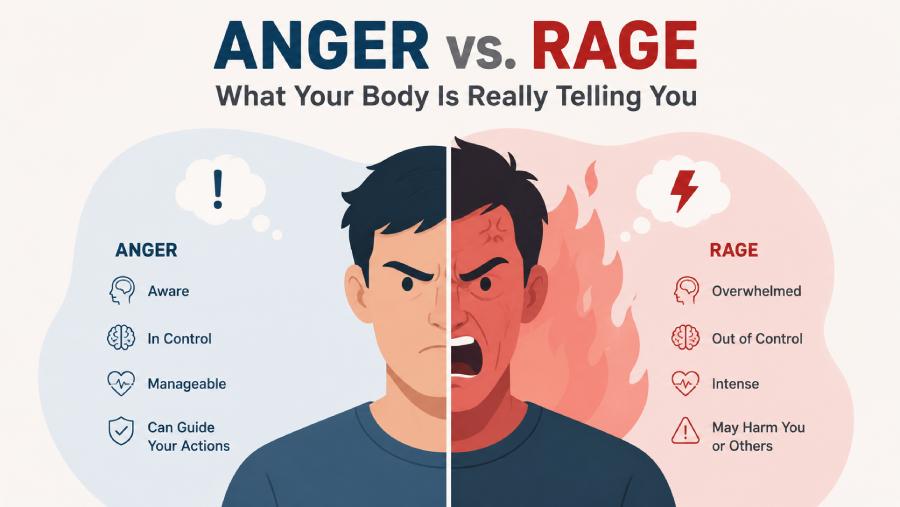
Most people have felt their jaw tighten during a frustrating argument, or noticed their heart rate spike when something genuinely unfair happened. Anger is a normal, human experience. But there are moments when that feeling crosses a line, and suddenly the emotion is running the show instead of you. Knowing where that line is, and why it exists, can make a real difference in how you manage your emotional life and your relationships.
This article breaks down the emotional and physiological differences between anger and rage, explains what happens inside the body during each state, looks at common triggers and warning signs, and offers grounded strategies for keeping intense emotions from causing lasting harm.
Why Anger Gets a Bad Reputation It Doesn’t Entirely Deserve
Anger is one of the six basic emotions identified by psychologist Paul Ekman, placing it alongside fear, disgust, surprise, happiness, and sadness. That classification matters because it signals that anger is not a character flaw or a sign of weakness. It is a biological signal, wired into human beings for good evolutionary reasons. When you feel wronged, threatened, or disrespected, anger is the internal alarm system firing off.
The problem is that cultural messaging tends to treat all anger as dangerous or shameful. Children are told to calm down. Adults are told to be professional. Over time, many people learn to suppress the feeling rather than process it. That suppression does not make anger disappear. Research published in the Journal of Personality and Social Psychology has shown that emotional suppression can actually amplify the intensity of negative emotions over time, making them harder to regulate when they do surface.
Anger, when acknowledged and expressed constructively, serves a purpose. It can motivate people to set boundaries, advocate for themselves, or address injustice. The goal is not to eliminate anger but to understand what it is communicating.
What Happens in the Body During Anger and Rage
Both anger and rage involve the sympathetic nervous system, the part of the body responsible for the fight-or-flight response. When you perceive a threat or injustice, the amygdala, an almond-shaped region deep in the brain, fires a signal that triggers the release of adrenaline and cortisol. Heart rate increases. Blood pressure rises. Muscles tighten. Digestion slows. The body is preparing to act.
In a state of manageable anger, the prefrontal cortex, the part of the brain associated with reasoning and decision-making, remains at least partially online. You can still think. You can still choose your words. The emotional response is present, but you retain some capacity to guide your behavior.
Rage is a different physiological experience. During a rage response, the activation of the amygdala becomes so intense that it effectively overrides the prefrontal cortex in what researchers sometimes call amygdala hijacking, a term popularized by psychologist Daniel Goleman in his work on emotional intelligence. At that point, rational thinking is severely compromised. Impulse control drops. People in a rage state often report afterward that they felt like a different person, because in a neurological sense, the deliberate, reasoning part of their brain had been temporarily sidelined.
| Feature | Anger | Rage |
| Intensity | Moderate; manageable | Extreme; overwhelming |
| Prefrontal cortex function | Partially active | Severely diminished |
| Impulse control | Present to some degree | Largely absent |
| Physical symptoms | Increased heart rate, muscle tension | Shaking, tunnel vision, loss of verbal control |
| Duration | Minutes to an hour | Can escalate rapidly; difficult to de-escalate |
| Trigger awareness | Usually clear to the person | Often feels disproportionate or unclear afterward |
| Risk of harm | Low if expressed constructively | Higher; actions may cause regret |
Common Triggers and Who Is Most Vulnerable
Anger and rage do not arise in a vacuum. Certain conditions make people more susceptible to intense emotional responses. Sleep deprivation is a significant factor. A study published in the journal Sleep found that sleep-restricted participants showed significantly greater anger and less ability to adapt to frustrating conditions compared to those who slept normally. Chronic stress, unresolved trauma, substance use, and certain medical conditions such as traumatic brain injury or hormonal imbalances can also lower the threshold at which a person moves from irritation to full-blown rage.
Common situational triggers include perceived disrespect or humiliation, feeling powerless or unheard, injustice whether real or perceived, physical discomfort like pain or hunger, and accumulated frustrations that build over time before one small event tips the balance.
It is also worth noting that some people develop patterns of rage that are rooted in early experiences. Childhood environments where anger was either modeled aggressively or completely forbidden can shape a person’s emotional regulation style well into adulthood. Attachment trauma in particular has been linked to difficulties tolerating frustration without escalating.
Recognizing the Warning Signs Before Escalation
One of the most practical skills a person can develop is learning to notice the physical and cognitive cues that signal escalating anger before it reaches a rage state. The window between irritation and loss of control is narrow, but it is real, and it can be widened with practice.
- Clenching the jaw or fists without realizing it
- A sudden sensation of heat in the face or chest
- Narrowing of focus, sometimes called tunnel vision
- Thoughts that become repetitive or circular, often replaying the perceived offense
- Voice pitch rising or volume increasing involuntarily
- A strong urge to move, pace, or physically act
- Feeling that words are coming out before you have fully thought them through
These signals are not weaknesses. They are the body’s way of flagging that resources are being redirected. Treating them as useful information rather than things to be ashamed of makes it easier to respond rather than react.
The Difference Between Expressing and Exploding
There is a meaningful distinction between expressing anger and exploding into rage, and it comes down to whether you are communicating or simply discharging. Expressing anger involves stating how you feel, why you feel it, and what you need, without attacking the other person’s character or resorting to threats. Exploding tends to involve blame, personal attacks, and behavior that bypasses the actual issue entirely.
A resource like understanding anger versus rage can be valuable here because it frames these emotional states as points on a spectrum rather than completely separate experiences. That framing helps people recognize that movement along the spectrum is gradual, which means intervention is possible before the situation becomes unmanageable.
Healthy expression of anger tends to use first-person language, stays focused on specific behaviors rather than global character judgments, and leaves room for the other person to respond. It can be direct and firm without being threatening. Rage expression, by contrast, often involves language that neither person can walk back easily, and the aftermath typically includes regret, damaged trust, and sometimes real-world consequences.
Evidence-Based Strategies for Managing Intense Anger
No single technique works for every person in every situation, but research points to several approaches that have meaningful support across multiple studies.
Physiological De-escalation
Because anger and rage are fundamentally physiological events, physical interventions can be effective. Slow, diaphragmatic breathing activates the parasympathetic nervous system, which counteracts the fight-or-flight response. Specifically, extending the exhale to be longer than the inhale, such as inhaling for four counts and exhaling for six, has been shown to reduce heart rate and lower the perception of emotional intensity. Cold water on the face or wrists can also interrupt a stress response quickly.
Cognitive Restructuring
Cognitive behavioral approaches to anger management focus on identifying and challenging the thought patterns that fuel escalation. A common pattern is what therapists call “should” thinking, where a person holds rigid rules about how others must behave, and experiences intense anger whenever those rules are violated. Replacing absolutist thinking with more flexible interpretations does not mean tolerating poor treatment. It means reducing the frequency and intensity of emotional fires that get started by predictable frustrations.
Structured Time-Outs
Removing yourself from a triggering situation is not avoidance if done with intention. A structured time-out means agreeing in advance with yourself or a partner that when certain signals appear, you will pause the interaction for a set period, typically at least 20 minutes, engage in a calming activity rather than ruminating, and then return to the conversation. The 20-minute threshold is significant because that is roughly the time it takes for adrenaline levels to begin declining after a stress response is triggered.
Professional Support
When anger or rage is causing repeated harm to relationships, employment, or personal wellbeing, working with a therapist trained in anger management or trauma-focused approaches is often the most direct path to lasting change. Dialectical behavior therapy, acceptance and commitment therapy, and trauma-informed cognitive behavioral therapy have all shown positive outcomes for people struggling with emotional dysregulation. Medication may also be appropriate in some cases, particularly when underlying conditions like anxiety, PTSD, or mood disorders are contributing to the intensity of anger responses.
A Final Word on Taking Anger Seriously
Anger is not the enemy. Unmanaged escalation is. The distinction between a feeling that signals something meaningful and a reactive state that causes harm is one worth paying close attention to. Learning your own emotional patterns, the triggers, the physical cues, the thoughts that speed the process along, gives you more choices in moments that used to feel entirely out of your hands. That kind of self-knowledge is not a soft skill. It is one of the more practical things a person can build over a lifetime.