
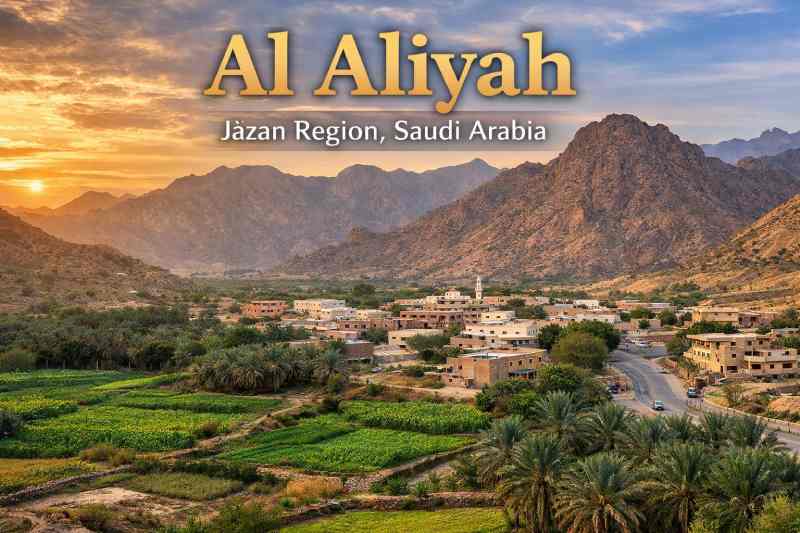
Al Aliyah is a small but meaningful settlement located in the Jazan Region of southwestern Saudi Arabia. Though it may not appear on international travel lists or major economic maps, Al Aliyah represents the authentic rural character of the Kingdom’s southern territories. Villages like this form the backbone of local identity, tribal heritage, agricultural activity, and regional continuity.
Situated near the Yemeni border, this settlement exists within a landscape shaped by mountains, desert plains, and coastal influences. Understanding Al Aliyah requires looking beyond population size or urban development. It is about geography, climate, culture, and how traditional communities adapt within modern Saudi Arabia.
Geographic Location and Setting
Where Is Al Aliyah Located?
Al Aliyah lies in the southwestern corner of Saudi Arabia, within Jazan Region. The approximate coordinates are 17°16′18″ N and 42°32′21″ E. The region itself borders Yemen to the south and the Red Sea to the west.
This part of Saudi Arabia differs significantly from central desert regions. While Riyadh and surrounding areas are dominated by vast dry plains, Jazan contains:
-
Coastal lowlands
-
Fertile agricultural areas
-
Mountain ranges
-
Seasonal valleys (wadis)
The terrain around Al Aliyah typically includes arid land mixed with cultivated fields, depending on elevation and access to water sources.
Natural Landscape
The southwestern geography creates a diverse environment. Nearby areas include:
-
Foothills that connect to the Asir mountain range
-
Agricultural patches where rainfall supports farming
-
Semi-arid open land suitable for livestock
Unlike heavily urbanized Saudi cities, the landscape around Al Aliyah feels open and expansive. The sky is wide, the terrain rugged, and the sense of community intimate.
Climate and Environmental Conditions
Climate Type
Al Aliyah experiences a hot desert climate (Köppen BWh classification). This means:
-
Long, hot summers
-
Mild winters
-
Limited annual rainfall
-
High evaporation rates
However, southwestern Saudi Arabia sometimes receives slightly more rainfall than the central Najd plateau due to its geographic position and occasional seasonal weather systems.
Seasonal Overview
Summer temperatures can rise significantly, often exceeding 40°C (104°F). Winter temperatures are more moderate, making it the most comfortable season of the year.
Rainfall is not consistent, but when it occurs, it can transform the surrounding land temporarily, supporting agriculture and grazing.
Environmental adaptation is central to life in Al Aliyah. Homes are built to manage heat, and farming practices are adjusted to water availability.
Historical and Tribal Context
Traditional Roots
Villages in Jazan Region, including Al Aliyah, are closely tied to tribal history. Southern Saudi Arabia has long been shaped by tribal affiliations, family lineage, and regional identity.
Although detailed public records about Al Aliyah specifically are limited, settlements in this region traditionally developed around:
-
Access to water sources
-
Agricultural suitability
-
Tribal land divisions
-
Trade routes connecting Yemen and western Saudi Arabia
For centuries, southwestern Arabia served as a cultural bridge between different parts of the Arabian Peninsula.
Cultural Identity
Residents of Al Aliyah typically maintain strong ties to heritage. Traditions may include:
-
Tribal gatherings
-
Oral storytelling
-
Local dialect variations
-
Traditional dress during special occasions
Community relationships are central to social structure. In rural settlements, extended families often live close to one another, reinforcing cultural continuity.
Population and Community Life
Settlement Size
Al Aliyah is considered a populated place or rural locality rather than a city. Population density is relatively low compared to urban centers such as Jazan City or Abha.
Daily life is slower-paced and community-oriented.
Social Structure
Rural communities often emphasize:
-
Strong family bonds
-
Shared responsibilities
-
Respect for elders
-
Religious observance
Mosques typically serve as central gathering points. Friday prayers and religious celebrations help maintain social cohesion.
Community members may work in nearby towns while maintaining their homes in Al Aliyah, balancing traditional living with modern employment.
Economic Activities in Al Aliyah
Agriculture
Agriculture plays an important role in many parts of Jazan Region. While not every settlement is heavily farm-based, southwestern Saudi Arabia is known for crops such as:
-
Sorghum
-
Millet
-
Corn
-
Fruits in suitable microclimates
-
Date palms
Water availability determines productivity. Where irrigation systems exist, cultivation increases.
Livestock
Livestock rearing is another common economic activity. Goats, sheep, and occasionally camels are raised in rural areas.
Animal husbandry provides:
-
Meat
-
Milk
-
Income stability
-
Cultural significance
Employment Beyond the Village
Many residents may commute to larger cities within the region for work in:
-
Government services
-
Education
-
Healthcare
-
Retail and trade
This connection to urban centers helps sustain smaller settlements like Al Aliyah.
Infrastructure and Accessibility
Roads and Transportation
Road networks in Jazan Region have improved significantly in recent decades. While Al Aliyah itself is small, access to larger highways allows residents to travel to nearby cities.
Infrastructure development in Saudi Arabia has expanded connectivity even in rural zones.
Public Services
Basic utilities such as electricity and water services are typically managed through regional government programs.
For advanced healthcare, higher education, or specialized services, residents usually travel to Jazan City or other larger towns.
Cultural Traditions and Lifestyle
Daily Living
Life in Al Aliyah is structured around simplicity and community values. Homes are often modest and designed to manage climate conditions.
Daily routines may include:
-
Early morning work due to heat
-
Agricultural tasks
-
Social visits
-
Religious obligations
Food and Cuisine
Southern Saudi cuisine reflects agricultural roots. Meals may include:
-
Traditional flatbread
-
Meat-based dishes
-
Grain-based meals
-
Local spices
Food preparation and sharing remain central to hospitality traditions.
Relationship with Jazan Region
Importance of the Region
Jazan Region is one of Saudi Arabia’s most culturally distinct provinces. It has:
-
Coastal access to the Red Sea
-
Mountainous terrain inland
-
Agricultural production
-
Cultural diversity
Being part of this region gives Al Aliyah geographical and administrative identity.
Economic and Strategic Significance
Southwestern Saudi Arabia has gained attention for development initiatives. While small villages remain traditional, regional growth contributes indirectly to improved living standards.
Projects across Jazan Region influence transportation, trade, and agriculture.
Modern Development and Future Outlook
Rural Transformation
Saudi Arabia’s Vision 2030 includes rural development strategies. While major cities receive more attention, smaller communities benefit from:
-
Infrastructure upgrades
-
Education improvements
-
Telecommunications expansion
Al Aliyah may not be a major development hub, but connectivity and modernization gradually reach rural settlements.
Preservation of Identity
Despite modernization, maintaining cultural identity remains essential. Rural settlements preserve:
-
Tribal heritage
-
Traditional practices
-
Community-based living
Balancing development with tradition defines the future of places like Al Aliyah.
Why Al Aliyah Matters
Even small settlements contribute to national identity. Al Aliyah represents:
-
The agricultural roots of southwestern Saudi Arabia
-
The continuity of tribal communities
-
The importance of rural resilience
-
A quieter alternative to urban life
Understanding such settlements provides deeper insight into the Kingdom beyond skyscrapers and mega-projects.
FAQs
1. Where exactly is Al Aliyah located in Saudi Arabia?
It is located in the Jazan Region of southwestern Saudi Arabia, near the Yemeni border, within a rural landscape of plains and foothills.
2. Is Al Aliyah a city or a village?
It is classified as a small populated place or rural settlement rather than a city.
3. What is the climate like in Al Aliyah?
The area experiences a hot desert climate with very warm summers, mild winters, and limited rainfall.
4. What are the main economic activities in Al Aliyah?
Agriculture, livestock rearing, and employment in nearby towns are common sources of income.
5. Is Al Aliyah significant for tourism?
It is not a major tourist destination, but it offers insight into traditional rural life in southwestern Saudi Arabia.
Conclusion
Al Aliyah may not appear on major travel maps, but it carries the essence of rural southwestern Saudi Arabia. Situated in Jazan Region, it reflects agricultural traditions, tribal heritage, and community-focused living. The climate shapes daily routines, the landscape influences economic activities, and cultural identity remains deeply rooted.