

Coffee has always been more than just a beverage. It is a ritual, a comfort, a social glue that keeps people together — in offices, cafés, and early morning kitchens around the world. But when the COVID-19 pandemic hit in 2020 and flipped everyday life upside down, even something as simple as a cup of coffee was never quite the same again. From whipped Dalgona drinks going viral on TikTok to people suddenly investing in home espresso machines, pandemic coffee became a genuine cultural and economic phenomenon worth talking about. And honestly? There is a lot more to it than most people realize.
What Exactly Is “Pandemic Coffee”?
When people use the term “pandemic coffee,” they are usually referring to one of a few things. It could mean the dramatic shift in how and where people consumed coffee during the height of the COVID-19 lockdowns. It could refer to the wildly popular DIY coffee trends that exploded on social media during that period. Or it could simply describe the broader transformation that the global coffee industry went through — and is still navigating to this day.
All three interpretations are valid, and all three are deeply connected. The pandemic did not just change coffee habits temporarily. It restructured an entire industry, launched new brands, killed off old ones, and permanently altered the expectations of the modern coffee drinker. Understanding pandemic coffee means understanding a perfect storm of boredom, creativity, economic pressure, and consumer curiosity happening all at once.
The Rise of Dalgona Coffee: The Drink That Defined a Lockdown
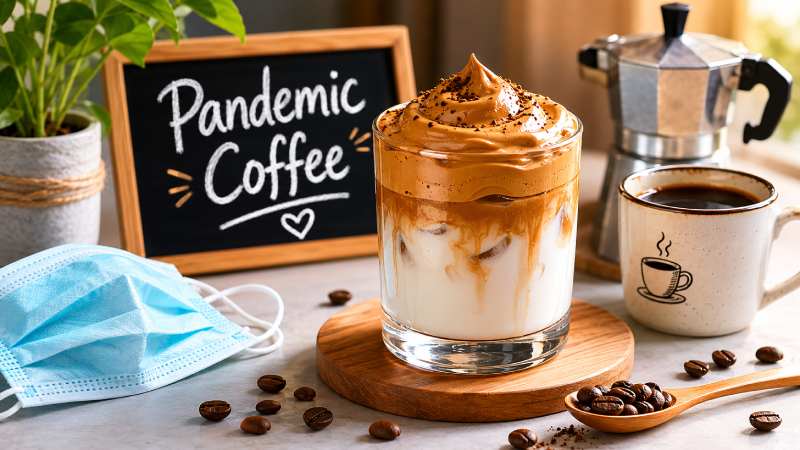
If there is one image that perfectly captures pandemic coffee culture, it is a glass of iced milk topped with a mountain of thick, caramel-colored foam. That is Dalgona coffee, and for a solid chunk of 2020 and 2021, it was absolutely everywhere.
The drink itself is not complicated. You whip together equal parts instant coffee, sugar, and hot water until the mixture turns into a stiff, glossy foam, then spoon it over cold milk. The result looks impressive, tastes surprisingly good, and requires nothing more than a bowl, a whisk (or a hand mixer if you want to save your arms), and a few minutes. That simplicity was the whole point. People stuck at home with nothing to do found a small creative outlet in making Dalgona coffee, photographing it, and posting it online.
The numbers were staggering. YouTube videos with “Dalgona” in the title saw viewership spike by around 5,000 percent by the end of 2021. It trended on TikTok in dozens of countries simultaneously. It became a shared experience for millions of people who had never met and lived on opposite sides of the world — all connected by the same foamy cup of coffee sitting on their kitchen counter. In a time when so much felt out of control and isolating, Dalgona coffee was oddly unifying. It was one of the first major examples of a food trend spreading not from restaurants or food media, but entirely organically through social platforms driven by people who were bored, creative, and craving connection.
How Lockdowns Shifted Coffee Consumption at Home
Before the pandemic, a huge chunk of coffee consumption happened outside the home. Grabbing a latte on the way to work, meeting a friend at a café, ordering an espresso with lunch — these were daily habits for millions of people. When lockdowns hit and those environments disappeared overnight, people had to rethink their entire coffee routine.
At first, many people defaulted to whatever they had at home — instant coffee, a basic drip machine, or whatever bag of ground coffee had been sitting in the pantry. But it did not take long for something interesting to happen. People started actually paying attention to their coffee. They had time to experiment, research, and invest in a way that the busy pace of pre-pandemic life rarely allowed.
Sales of home espresso machines, French presses, pour-over kits, and coffee grinders all surged during the lockdown period. Subscription coffee services saw massive growth as consumers discovered the convenience of having freshly roasted beans delivered to their door. Specialty coffee roasters who had always sold primarily to cafés and restaurants suddenly found a thriving direct-to-consumer audience hungry for premium products and willing to pay for quality they could enjoy at home.
The data on overall coffee consumption during this time was mixed — some studies showed it increasing, others showed it staying flat — but what is undeniable is that the type of coffee people drank and the care they put into making it shifted significantly. People were no longer just consuming caffeine. They were brewing it with intention.
The Specialty Coffee Boom: A Pandemic Silver Lining
One of the most significant and lasting outcomes of pandemic coffee culture is the accelerated growth of the specialty coffee market. Specialty coffee — referring to high-quality, single-origin beans sourced with transparency and roasted with precision — had already been growing steadily before 2020. But the pandemic turbocharged that growth in ways nobody quite anticipated.
When cafés shut down, consumers lost access to the barista-made specialty drinks they had come to love. Rather than simply giving up on quality coffee, many of them went looking for ways to replicate the experience at home. This led them directly into the world of specialty roasters, brewing guides, and coffee education — a world that had previously felt intimidating or niche to the average consumer.
Specialty roasters who adapted quickly to e-commerce and direct shipping thrived during this period. The pandemic forced them to stop relying on wholesale café accounts and build direct relationships with customers — which, in the long run, turned out to be a healthier business model. Consumer preferences also shifted during this time, moving away from the traditional heavy, milk-heavy drinks associated with chain coffee shops and toward more nuanced flavor profiles. People started caring about origin, roast level, and brew method in a way that had never been mainstream before.
The Coffee Industry’s Struggle: Not Everyone Survived
It would be dishonest to paint pandemic coffee as purely a story of growth and creativity. For every home barista who discovered their love of pour-over coffee, there was a café owner watching their livelihood disappear. The coffee shop industry was devastated by the pandemic, and many businesses never recovered.
Coffee shops are built on the in-person experience — the ambiance, the social interaction, the sense of being part of a neighborhood. You cannot replicate that through curbside pickup or a delivery app. When stay-at-home orders were announced, foot traffic collapsed. Even cafés that managed to stay open for takeout saw revenues plummet in some cases by 90 percent or more. Iconic specialty chains shuttered locations permanently. Smaller independent shops that had spent years building a loyal community were forced to close within months.
The supply chain was hit hard too. Border closures, reduced freight flights, and shipping bottlenecks made it difficult and expensive to move green coffee beans from producing countries to roasters around the world. Packaging delays added further complications. Roasters were dealing with rising demand from consumers on one side and a chaotic supply chain on the other — a genuinely difficult position to be in.
Staff redundancies were common. Many skilled baristas lost their jobs and left the industry entirely, creating a talent shortage that coffee businesses are still feeling the effects of years later. The pandemic exposed just how fragile the economics of the café model can be, and it forced an entire industry to reckon with that vulnerability in real time.
New Coffee Brands Born From the Pandemic
One unexpected outcome of the pandemic was a wave of new coffee businesses that launched specifically because of it. With more people at home, lower commercial rents available, and a growing appetite for quality home coffee, conditions were — somewhat counterintuitively — ripe for entrepreneurship.
Several specialty roasters that launched during 2020 and 2021 found early success precisely because they built direct-to-consumer e-commerce operations from day one, without the overhead of a physical café. Others were founded by people who had lost their jobs in the hospitality industry and decided to channel their coffee knowledge and passion into their own business. The pandemic, for all its devastation, also created space for people to make bold moves they might not have otherwise considered.
Social media played a critical role in helping these new brands find their audience. Platforms like Instagram and TikTok allowed small roasters to build loyal followings without traditional marketing budgets, simply by showing their process, sharing their sourcing stories, and engaging directly with coffee-curious consumers who were spending more time online than ever before.
How Coffee Culture Was Permanently Reshaped
The pandemic did not just temporarily disrupt coffee habits — it permanently altered them in ways that are still playing out. The hybrid work model that emerged from the pandemic years means that many people now spend at least part of their week working from home, which keeps home coffee consumption elevated compared to pre-pandemic levels. People who invested in quality home brewing equipment during the lockdowns did not simply abandon those habits when the world reopened.
Café culture itself has evolved too. Consumers who spent two years learning about coffee at home returned to cafés with higher expectations and more knowledge. They were asking better questions, exploring more adventurous menu items, and appreciating the craft behind specialty drinks in a way they had not before. This has pushed cafés to raise their standards, invest in staff training, and prioritize quality and experience over volume.
Sustainability also became a more prominent conversation during the pandemic, as disruptions in the global supply chain made the fragility of the coffee trade impossible to ignore. More consumers are now interested in where their coffee comes from, how farmers are compensated, and what practices roasters use. Ethical sourcing is no longer just a nice-to-have — for a growing segment of coffee drinkers, it is a deciding factor.
FAQs
What is pandemic coffee?
Pandemic coffee refers to the shift in coffee habits during COVID-19, when people started brewing and experimenting with coffee at home instead of visiting cafés.
What coffee trend went viral during the pandemic?
Dalgona coffee went massively viral — a simple whipped mixture of instant coffee, sugar, and hot water spooned over cold milk that took over TikTok and Instagram worldwide.
Did the pandemic hurt the coffee industry?
Yes, significantly. Many cafés permanently closed due to lost foot traffic, while roasters faced supply chain disruptions and steep revenue drops almost overnight.
Did people drink better coffee during lockdowns?
Many did. With time on their hands, people invested in quality beans, home brewing equipment, and specialty coffee — permanently raising their standards for a good cup.
Did any coffee brands launch during the pandemic?
Yes. Several direct-to-consumer specialty roasters launched during 2020–2021 and built loyal audiences through social media, many of which are still thriving today.
Conclusion
Pandemic coffee is, in many ways, a microcosm of what the pandemic did to consumer culture at large. It accelerated existing trends, forced painful adaptations, created unexpected opportunities, and left behind a consumer who is more informed, more intentional, and more demanding than before.
The home barista is here to stay. The specialty coffee market is bigger and more accessible than ever. The café industry is leaner and more focused. And somewhere in the world right now, there is probably someone still making Dalgona coffee — because trends born out of genuine human creativity have a way of sticking around long after the moment that inspired them has passed.
Pandemic coffee was never really just about coffee. It was about how people find comfort, community, and small joys during difficult times. And that, more than any brewing method or viral trend, is the part of the story that genuinely matters.