

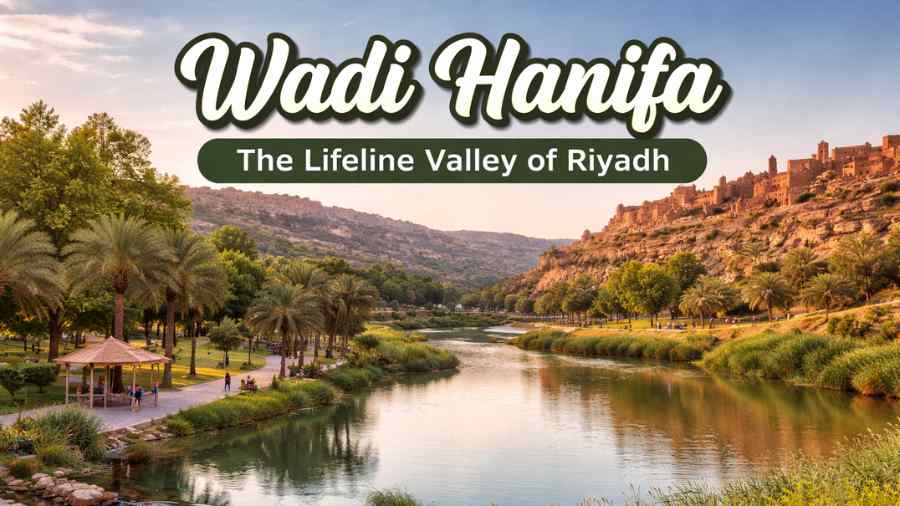
Wadi Hanifa is one of the most remarkable natural landscapes in Saudi Arabia and a defining geographic feature of the Riyadh region. Stretching across the heart of the Najd plateau, this historic valley has shaped settlement patterns, agriculture, culture, and modern urban development for centuries. Long before Riyadh became a global capital, Wadi Hanifa served as a vital corridor of life, providing water, fertile land, and natural protection to early communities.
Geographic Location and Natural Setting
Wadi Hanifa runs for approximately 120 kilometres through the Riyadh region, flowing from the north-west to the south-east. It forms a natural drainage system that collects rainwater from surrounding highlands and channels it through the valley floor. The wadi cuts through limestone formations typical of the Najd plateau, creating gentle slopes, terraces, and fertile pockets of land.
The valley’s geography made it naturally suitable for settlement. Seasonal water flow enriched the soil, while the surrounding cliffs and elevated land offered shelter from harsh desert winds. Even in an arid climate, Wadi Hanifa maintained vegetation, making it a green ribbon in an otherwise dry landscape.
Historical Importance and Early Settlements
The historical value of Wadi Hanifa cannot be overstated. For centuries, tribes and farming communities settled along its banks, relying on its water and arable land. Palm groves, small farms, and villages flourished in the valley, forming the backbone of early life in the region.
The valley is closely associated with the Banu Hanifa tribe, from whom it takes its name. This tribe played a key role in the early history of central Arabia. Over time, the settlements along Wadi Hanifa laid the groundwork for the emergence of Diriyah and later Riyadh, making the valley central to the political and cultural development of Saudi Arabia.
Relationship with Diriyah and Riyadh
One of the most significant aspects of Wadi Hanifa is its connection to Diriyah, the historic capital of the First Saudi State. Diriyah developed along the western edge of the valley, benefiting from its resources and strategic location. The wadi provided water for agriculture and daily life while acting as a natural boundary and defence line.
As Riyadh expanded, it grew across and around Wadi Hanifa. Rather than disappearing under urban sprawl, the valley became an integral part of the city’s structure. This relationship between the natural environment and the built city makes Wadi Hanifa unique among major urban centres in the region.
Environmental Challenges in the Modern Era
With rapid urbanisation during the twentieth century, Wadi Hanifa faced serious environmental challenges. Industrial discharge, untreated wastewater, and unregulated construction degraded water quality and natural habitats. In some areas, the valley was treated as a dumping ground rather than a natural asset.
These issues threatened not only the ecosystem but also public health and the cultural value of the valley. Recognising the urgency of the situation, authorities and planners began to rethink how Wadi Hanifa should be managed and protected for future generations.
Restoration and Sustainable Development
The restoration of Wadi Hanifa is widely regarded as one of the most successful environmental rehabilitation projects in the Middle East. A comprehensive development plan was implemented to clean the water, restore natural habitats, and integrate the valley into Riyadh’s urban life.
The project focused on natural water treatment systems, wetland creation, and landscape rehabilitation. Instead of relying solely on mechanical infrastructure, planners used ecological methods to improve water quality and biodiversity. This approach not only restored the valley’s health but also reduced long-term maintenance costs and environmental impact.
Biodiversity and Ecological Value
Today, Wadi Hanifa supports a diverse range of plant and animal life. Native vegetation has been reintroduced, stabilising soil and providing habitat for birds, insects, and small mammals. Wetlands along the valley floor act as natural filters, improving water quality and supporting aquatic life.
Bird species, both resident and migratory, are commonly observed in the restored areas. This renewed biodiversity highlights the valley’s role as an ecological corridor within an urban setting. It also demonstrates how thoughtful environmental planning can revive natural systems even in densely populated regions.
Recreational and Social Spaces
Beyond its ecological role, Wadi Hanifa has become a major recreational destination for residents of Riyadh. Walking trails, cycling paths, picnic areas, and scenic viewpoints attract families, fitness enthusiasts, and nature lovers. The valley offers a rare opportunity to experience nature without leaving the city.
These spaces contribute to quality of life by providing areas for relaxation, social interaction, and physical activity. In a fast-growing metropolis, access to such natural environments plays an important role in mental and physical well-being.
Cultural Identity and Heritage
Wadi Hanifa is more than a natural feature; it is a living part of Saudi Arabia’s cultural identity. Poetry, local stories, and historical accounts often reference the valley as a place of life, prosperity, and community. Its landscapes have witnessed key moments in regional history, from early tribal settlements to the rise of the Saudi state.
Preserving Wadi Hanifa means preserving a tangible connection to the past. The valley serves as an open-air reminder of how people once lived in harmony with their environment, relying on natural systems rather than overpowering them.
Role in Vision and Urban Planning
Modern urban planning in Saudi Arabia increasingly emphasises sustainability, heritage, and liveability. Wadi Hanifa aligns perfectly with these goals. It demonstrates how natural landscapes can be integrated into city planning rather than replaced by concrete and asphalt.
The valley now functions as a green spine within Riyadh, influencing nearby development and setting standards for future projects. Its success has inspired similar initiatives across the Kingdom, showing that environmental restoration and urban growth can move forward together.
Tourism and Educational Value
Wadi Hanifa also holds growing value as a tourism and educational destination. Visitors can explore restored landscapes, learn about ecological engineering, and understand the historical significance of the region. Schools and universities use the valley as a real-world example of sustainable development and environmental science.
For international visitors, Wadi Hanifa offers insight into a lesser-known side of Saudi Arabia, one that highlights nature, heritage, and long-term planning rather than only modern skylines.
The Future of Wadi Hanifa
Looking ahead, Wadi Hanifa’s future depends on continued protection, responsible use, and public awareness. Ongoing monitoring of water quality, biodiversity, and land use is essential to ensure that the valley remains healthy. Community involvement and education will also play a key role in preserving the valley’s achievements.
As Riyadh continues to grow, Wadi Hanifa stands as proof that progress does not have to come at the expense of nature. Instead, it shows how respecting natural systems can enhance urban life and create lasting value.
Conclusion
Wadi Hanifa is a powerful example of how history, nature, and modern development can coexist in harmony. From its role as a lifeline for early settlements to its transformation into a restored ecological and recreational corridor, the valley reflects the evolving relationship between people and their environment in Saudi Arabia. By valuing and protecting Wadi Hanifa, the Kingdom preserves not only a natural landscape but also a vital part of its cultural and historical identity.