
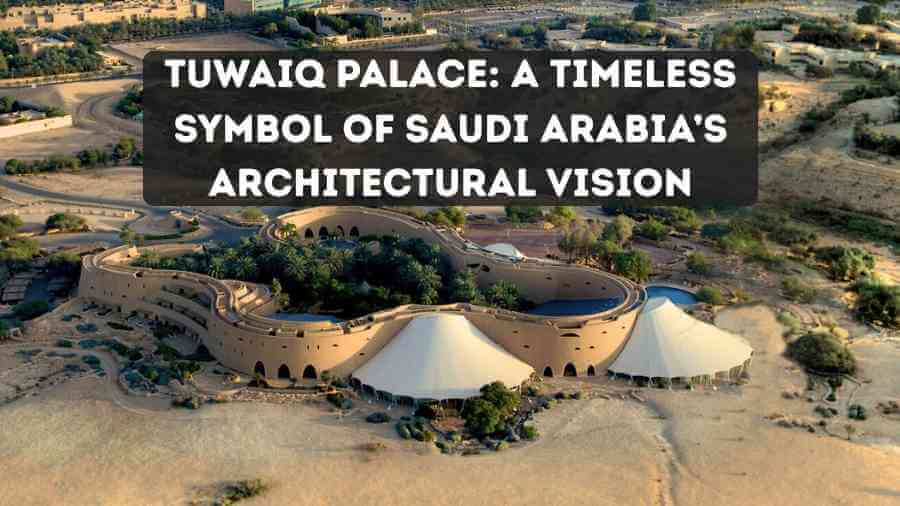
It represents far more than a landmark in Riyadh. It stands as a powerful expression of Saudi Arabia’s cultural confidence, architectural intelligence, and ability to harmonise heritage with innovation. Located within the Diplomatic Quarter, it has earned global recognition for its design philosophy, environmental sensitivity, and its role in presenting Saudi culture to the world.
Understanding the Location and Setting of Tuwaiq Palace
Tuwaiq Palace is located in the Diplomatic Quarter of Riyadh, an area designed to host embassies, cultural institutions, and official residences. The setting was carefully chosen to reflect dignity, openness, and harmony with nature.
The palace overlooks Wadi Hanifa, a natural valley that has been central to life in the region for centuries. This elevated position gives the palace sweeping views of the landscape while reinforcing a connection to Saudi Arabia’s geographical and historical roots.
Rather than dominating its surroundings, the palace integrates into the terrain. Its long, curving structure mirrors the natural contours of the land, creating a dialogue between architecture and environment.
The Vision Behind Tuwaiq Palace
Tuwaiq Palace was conceived during a period when Saudi Arabia was actively shaping a modern national identity. The aim was not to replicate Western architectural models, but to create something unmistakably Saudi, grounded in local traditions while embracing contemporary design principles.
The palace was originally designed as a diplomatic and cultural centre. Its purpose was to welcome international guests, host official events, and serve as a space where Saudi hospitality could be experienced in its most refined form. Every design choice reflects this mission, from the openness of its courtyards to the protective strength of its walls.
Architectural Design Philosophy
The architecture of Tuwaiq Palace is often described as both bold and restrained. At its core is a dramatic, continuous wall that stretches across the site. This wall symbolises protection and permanence, echoing the defensive walls of traditional Najdi settlements.
Inside this strong exterior lies a series of gardens, courtyards, and shaded spaces that represent the concept of an oasis. This contrast between outward strength and inward calm is central to the palace’s design philosophy.
The palace avoids excessive ornamentation. Instead, it relies on proportion, light, shadow, and material quality to create beauty. Stone, concrete, and tensile structures are used in ways that respond intelligently to the desert climate.
Environmental and Climatic Intelligence
One of the most remarkable aspects of Tuwaiq Palace is how it responds to Saudi Arabia’s climate. Long before sustainability became a global trend, the palace incorporated passive cooling strategies rooted in traditional Arabian architecture.
Shaded walkways, thick walls, and carefully positioned openings reduce heat gain while allowing natural ventilation. Courtyards act as cooling lungs, lowering temperatures and creating comfortable outdoor spaces even in warmer months.
The palace demonstrates that modern architecture in the Middle East does not need to fight the climate. Instead, it can work with it, drawing inspiration from centuries of regional building knowledge.
Cultural Symbolism and Saudi Identity
Tuwaiq Palace is deeply symbolic. Its form references tents, fortifications, and desert landscapes that are integral to Saudi heritage. At the same time, its execution is unmistakably modern, reflecting a nation that respects its past while confidently looking forward.
For international visitors, the palace serves as an introduction to Saudi values. Hospitality, privacy, community, and respect for nature are all expressed through spatial design rather than words.
For Saudis, the palace stands as a reminder that national identity can be expressed through thoughtful architecture, not imitation.
Role in Diplomacy and Cultural Exchange
Since its completion, Tuwaiq Palace has played a significant role in hosting diplomatic receptions, cultural festivals, and official gatherings. It has welcomed heads of state, ambassadors, artists, and intellectuals from around the world.
The palace’s layout encourages interaction without sacrificing formality. Large halls accommodate ceremonies, while smaller courtyards provide intimate spaces for conversation. This flexibility has made it a preferred venue for high-level events.
Through these functions, the palace has helped position Saudi Arabia as a nation that values dialogue, culture, and mutual respect.
Recognition and Global Appreciation
Tuwaiq Palace has received international acclaim for its architectural excellence. It is frequently cited in academic studies, architectural exhibitions, and professional discussions as a benchmark for culturally rooted modern design.
Its recognition goes beyond awards. The palace is studied as an example of how architecture can serve as cultural diplomacy, conveying values and identity without reliance on language.
This global appreciation has reinforced Saudi Arabia’s reputation as a country capable of producing world-class architecture that is both authentic and innovative.
Evolution and Future Vision
As Saudi Arabia continues to transform under its long-term development goals, Tuwaiq Palace remains relevant. Plans to adapt the palace for new uses reflect a broader national strategy of preserving heritage while reimagining its role for future generations.
Rather than freezing the palace in time, these efforts aim to ensure it continues to contribute to cultural life, tourism, and international engagement. This approach reflects a mature understanding of heritage as something living and evolving.
Why Tuwaiq Palace Matters Today
In a world where many cities struggle with architectural identity, Tuwaiq Palace offers a clear lesson. It proves that buildings can be modern without losing their cultural soul, and that tradition can inspire innovation rather than limit it.
For architects, planners, and cultural thinkers, the palace serves as a case study in responsible, meaningful design. For visitors, it offers an experience that is both visually striking and emotionally resonant.
Above all, Tuwaiq Palace matters because it tells a story. A story of place, people, and purpose, expressed through stone, space, and silence.
Conclusion
Tuwaiq Palace stands as one of Saudi Arabia’s most important architectural achievements, not because of its scale or luxury, but because of its meaning. It captures the essence of Saudi identity in built form, balancing strength with serenity, tradition with modernity, and openness with privacy.
As Saudi Arabia continues to shape its future on the global stage, Tuwaiq Palace remains a powerful reminder that true progress does not require abandoning heritage. Instead, it flourishes when the past is understood, respected, and thoughtfully reimagined for generations to come.