

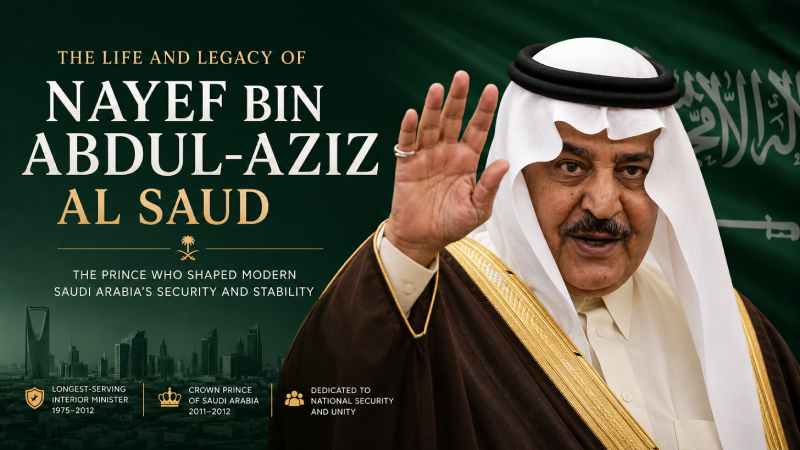
Nayef bin Abdulaziz Al Saud was one of the most influential political figures in the modern history of Saudi Arabia. For decades, he played a central role in shaping the kingdom’s internal security, political stability, and conservative governance policies. Although Saudi Arabia has produced many powerful princes, few maintained as much authority for as long as Prince Nayef.
Known for his firm approach toward national security and his strong commitment to preserving the traditional foundations of the Saudi state, Prince Nayef became one of the most respected — and sometimes controversial — leaders inside the royal family. His career stretched across several generations of Saudi rulers, allowing him to witness and influence major political transitions in the Middle East.
Many people outside Saudi Arabia first became familiar with his name when he was appointed Crown Prince in 2011. However, within the kingdom, he had already spent decades overseeing security affairs, anti-terrorism operations, and domestic governance. His long tenure as Interior Minister gave him immense influence over the direction of Saudi policy during critical periods of regional instability.
Early Life and Royal Background
Nayef bin Abdul-Aziz Al Saud was born on October 9, 1934, in Taif, Saudi Arabia. He was one of the many sons of Abdulaziz Ibn Saud, the founder and first king of modern Saudi Arabia. Being born into the royal family naturally placed him within the inner circle of political power from an early age.
Prince Nayef belonged to the influential “Sudairi Seven,” a powerful alliance of seven brothers born to Hassa bint Ahmed Al Sudairi. This group included several major Saudi leaders, such as King Fahd and King Salman. The Sudairi brothers became one of the strongest factions within the Saudi royal family and played a major role in government affairs for decades.
Unlike many modern politicians who rise through elections or party systems, Saudi royal leadership traditionally develops through family influence, governmental appointments, and internal trust within the monarchy. Prince Nayef was trained in governance and administration from a young age, preparing him for leadership responsibilities inside the kingdom.
His early exposure to politics helped him develop a deep understanding of tribal relations, regional diplomacy, and Saudi governance structures. These experiences would later shape his strict but highly organized leadership style.
Entry Into Government and Rise to Power
Prince Nayef began his political career relatively early. In the 1950s, he served as governor of the Riyadh region for a short period before taking on more significant responsibilities. His rise through the government hierarchy was steady rather than sudden, which helped him gain trust within the royal establishment.
One of the most important moments in his career came in 1975 when he was appointed Minister of Interior. This position would define his legacy and eventually make him one of the most powerful men in Saudi Arabia.
The Ministry of Interior in Saudi Arabia is not a small administrative office. It oversees national security, police operations, border control, immigration, civil defense, counterterrorism operations, and public order. By leading this ministry for decades, Prince Nayef gained enormous authority over internal affairs throughout the kingdom.
His appointment also came during a highly sensitive period for Saudi Arabia and the broader Middle East. Regional tensions, ideological conflicts, and growing extremist movements were beginning to challenge governments across the region. Prince Nayef’s leadership style quickly became associated with discipline, control, and strict enforcement of state authority.
Over time, he became known as one of the most experienced administrators inside the Saudi government. His influence extended beyond security matters and into broader national policy discussions.
Leadership During Security Challenges
One of the defining aspects of Prince Nayef’s career was his handling of national security crises. Saudi Arabia faced several major internal and regional threats during his time as Interior Minister, and his response to these challenges shaped his political identity.
The 1979 seizure of the Grand Mosque in Mecca became one of the most significant security crises in Saudi history. Militants occupied Islam’s holiest site, shocking the Muslim world and exposing weaknesses in the kingdom’s internal security systems. Although multiple Saudi institutions participated in resolving the crisis, Prince Nayef’s ministry played a major role in restoring order afterward.
In the following decades, the rise of extremist organizations created additional pressure on Saudi Arabia. During the early 2000s, Saudi authorities faced attacks linked to extremist networks, including groups connected to Al-Qaeda. Prince Nayef became one of the key architects of Saudi Arabia’s aggressive counterterrorism strategy.
His ministry developed extensive intelligence networks, rehabilitation programs, and security operations aimed at dismantling extremist cells. While critics sometimes described these policies as overly strict, supporters argued that they helped Saudi Arabia avoid larger-scale instability.
International governments, especially Western allies, often cooperated closely with Saudi intelligence and security agencies during this period. Prince Nayef gained recognition abroad for his role in regional counterterrorism coordination.
Political Views and Conservative Approach
Prince Nayef was widely recognized as a conservative figure within Saudi politics. He strongly supported traditional Islamic values, the monarchy, and centralized authority. His political philosophy focused heavily on stability, national unity, and preserving the kingdom’s religious and cultural foundations.
Unlike reform-oriented figures who pushed for rapid modernization, Prince Nayef generally favored gradual change. He believed that sudden political reforms could destabilize society and weaken the kingdom’s internal cohesion.
This cautious approach shaped many of his public statements. He often emphasized the importance of loyalty to the monarchy and warned against foreign political ideologies influencing Saudi society. During periods of regional unrest, especially during the Arab Spring, his emphasis on stability became even more significant.
At the same time, many Saudi citizens respected him for maintaining order during uncertain periods. Supporters viewed him as a leader who prioritized national security above political popularity. His supporters believed that his strict policies protected Saudi Arabia from the kinds of instability seen elsewhere in the Middle East.
Although international observers sometimes criticized aspects of Saudi domestic policy under his leadership, Prince Nayef remained highly influential within the kingdom and continued to receive strong backing from important segments of the royal family.
Becoming Crown Prince of Saudi Arabia
In 2011, Prince Nayef reached the highest point of his political career when he was appointed Crown Prince of Saudi Arabia after the death of Sultan bin Abdulaziz Al Saud.
The appointment confirmed his position as one of the kingdom’s senior leaders and placed him next in line to the Saudi throne. By this point, Prince Nayef already possessed decades of administrative and political experience, making him one of the most seasoned figures in the government.
As Crown Prince, he also became Deputy Prime Minister while continuing to oversee major state affairs. His appointment occurred during a highly sensitive regional environment marked by political uprisings across the Arab world.
Many international analysts closely watched Saudi Arabia during this period because the kingdom represented one of the most important political and economic powers in the Middle East. Prince Nayef’s leadership signaled continuity rather than dramatic policy changes.
Within Saudi Arabia, his appointment reassured conservative factions that the kingdom’s leadership would remain committed to traditional governance structures. His long experience in internal security also reinforced confidence among officials concerned about regional instability.
Although he served as Crown Prince for a relatively short time, the appointment symbolized the culmination of a lifetime spent within the highest levels of Saudi leadership.
Relationship With International Powers
Prince Nayef maintained important relationships with international governments throughout his political career. Saudi Arabia’s strategic partnerships with countries such as the United States made cooperation on security and intelligence issues especially important.
After the September 11 attacks and the global rise of counterterrorism operations, Saudi Arabia became a major player in international intelligence coordination. Prince Nayef frequently engaged with foreign officials regarding terrorism prevention, regional security, and extremist financing networks.
Despite political differences between Saudi Arabia and Western countries on issues such as human rights and domestic freedoms, foreign governments often recognized Saudi Arabia’s importance in maintaining regional stability. Prince Nayef’s ministry became a key partner in intelligence-sharing efforts.
His leadership style also reflected Saudi Arabia’s broader geopolitical strategy during that era: maintaining strong alliances while protecting the kingdom’s sovereignty and internal traditions.
Even critics acknowledged that his experience and influence made him one of the most important decision-makers in Middle Eastern politics during the late twentieth and early twenty-first centuries.
Family Influence and Political Legacy
Prince Nayef’s influence did not end with his own political career. Several of his sons later occupied major positions within the Saudi government, continuing the family’s role in national leadership.
One of the most well-known figures from his family is Mohammed bin Nayef, who later served as Interior Minister and Crown Prince himself. Mohammed bin Nayef became internationally recognized for his role in Saudi counterterrorism operations.
Another son, Saud bin Nayef, also became an important political figure inside the kingdom. These appointments reflected the lasting influence of Prince Nayef’s branch of the royal family.
Beyond family politics, Prince Nayef’s broader legacy remains deeply connected to Saudi Arabia’s security institutions. Many of the systems and policies developed during his tenure continued influencing the kingdom long after his death.
Supporters often describe him as a stabilizing figure who helped Saudi Arabia navigate dangerous regional conditions. Critics, meanwhile, argue that his conservative policies slowed political reform. Regardless of perspective, few deny his enormous impact on Saudi governance.
Death and Historical Importance
Prince Nayef bin Abdul-Aziz Al Saud died on June 16, 2012, in Geneva, Switzerland, after health complications. His death marked the end of one of the most influential political careers in Saudi Arabia’s modern history.
Following his passing, Saudi Arabia entered another period of leadership transition. His brother, King Salman, would later rise to the throne and guide the kingdom into a new era of economic and social transformation.
Historians often view Prince Nayef as one of the central architects of Saudi Arabia’s modern internal security system. His decades-long control of the Interior Ministry allowed him to shape national policy in ways few officials ever achieve.
He represented a generation of Saudi leadership that prioritized stability, centralized authority, and gradual evolution over rapid change. Whether viewed positively or critically, his role in Saudi history remains impossible to ignore.
Today, discussions about Saudi Arabia’s political development frequently include Prince Nayef because of his lasting influence on governance, security policy, and royal power structures.
FAQs
What was Nayef bin Abdul-Aziz Al Saud known for?
Nayef bin Abdul-Aziz Al Saud was best known for serving as Saudi Arabia’s long-time Interior Minister and later becoming Crown Prince.
When did Nayef bin Abdul-Aziz Al Saud become Crown Prince?
He became Crown Prince of Saudi Arabia in 2011 after the death of Prince Sultan bin Abdulaziz.
Was Nayef bin Abdul-Aziz Al Saud part of the Saudi royal family?
Yes, he was one of the sons of King Abdulaziz, the founder of modern Saudi Arabia.
What role did Nayef bin Abdul-Aziz Al Saud play in security?
He led Saudi Arabia’s internal security and counterterrorism operations for decades through the Ministry of Interior.
Who succeeded Nayef bin Abdul-Aziz Al Saud after his death?
After his death in 2012, Prince Salman later became Crown Prince and eventually King of Saudi Arabia.
Conclusion
Nayef bin Abdulaziz Al Saud remains one of the most significant political figures in Saudi Arabia’s modern history. From his early years within the royal family to his decades-long leadership of the Interior Ministry and eventual appointment as Crown Prince, he shaped major aspects of the kingdom’s political and security landscape.
His career reflected the priorities of a generation focused on protecting state stability during periods of regional conflict and ideological uncertainty. Through anti-terrorism operations, security reforms, and conservative governance, Prince Nayef became closely associated with Saudi Arabia’s approach to internal order and national protection.
Although opinions about his policies continue to differ, his influence on Saudi institutions and political structures remains undeniable. His legacy continues through the leaders, systems, and security strategies that emerged during his time in power.