

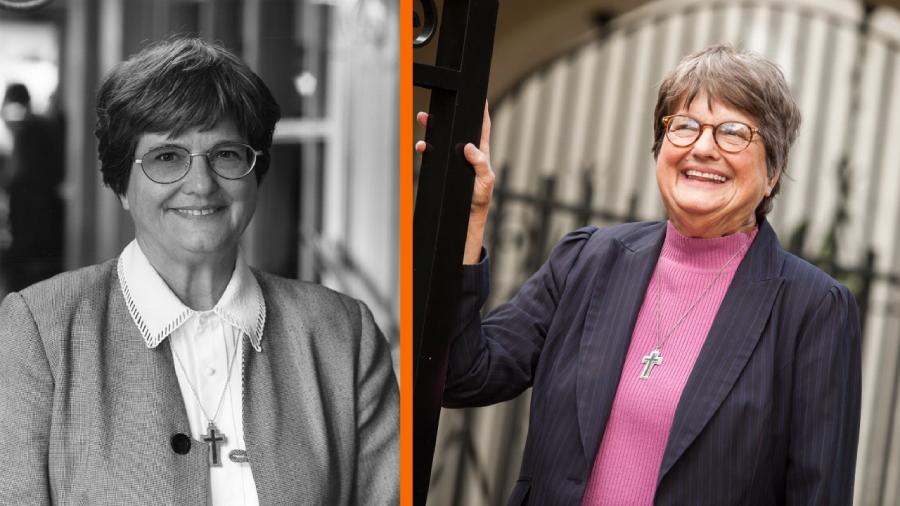
Helen Prejean is not the kind of person who stumbled into her life’s work by accident, and yet, in a beautifully ironic twist, that is exactly what happened. Born into a warm, deeply Catholic household in Baton Rouge, Louisiana, on April 21, 1939, she grew up surrounded by faith, family dinners, bedtime prayers, and parents who modeled what it meant to live with conviction. Nobody in the Prejean family could have predicted that this middle child, sandwiched between an older sister and a younger brother, would become the face of the anti-death penalty movement in the United States. But when you examine the values instilled in her from childhood, the trajectory makes a lot more sense. Helen Prejean age, now 87, reflects decades of relentless advocacy, spiritual growth, and an unwavering commitment to human dignity that has reshaped how millions of people think about capital punishment. Her story, though, does not begin on death row. It begins at home.
The Prejean Family Roots in Baton Rouge
Every great story has an origin, and for Helen, that origin is deeply rooted in the bayou culture of Louisiana. The Helen Prejean family was a tight-knit unit, the kind of family where Sunday Mass was non-negotiable and evening prayers were as routine as brushing your teeth. Her father, Louis Sebastian Prejean Sr., was a respected lawyer in Baton Rouge, a man who carried himself with the quiet dignity of someone who believed in justice long before his daughter would make it her life’s mission. Her mother, Augusta Mae Prejean, née Bourg, was a nurse by profession and a caretaker by nature. Together, they created a home that was equal parts warmth and discipline, faith and laughter.
What makes the Prejean household particularly interesting is that both Louis Sebastian Prejean Sr. and Augusta Mae Prejean had seriously considered religious vocations before they married each other. Louis Sr. had thought about the priesthood, and Augusta Mae had contemplated becoming a nun. Instead, they chose each other and built a family, but they carried that spiritual intensity into their parenting. Morning and evening, the Prejean children would kneel beside their mother to pray. It was in this atmosphere of deep faith that Helen first absorbed the idea that life had a purpose beyond personal comfort — an idea that would eventually lead her to death row.
Louis Sebastian Prejean Sr.: The Father Who Shaped a Movement
It would be easy to overlook the role of Louis Sebastian Prejean Sr. in the broader narrative of Helen’s activism, but that would be a mistake. While he never marched in protests or wrote bestselling books, his influence on Helen was foundational. As a lawyer, he understood the justice system from the inside. He knew its strengths and, more importantly, its flaws. Growing up with a father who practiced law meant that Helen was exposed to conversations about fairness, due process, and the rights of the accused from an early age.
Louis Sebastian Prejean Sr. was born in 1893 and lived until 1974, passing away when Helen was 35 years old. By that point, she had already joined the Sisters of Saint Joseph of Medaille, earned her degrees, and was teaching high school. But the seeds her father had planted were still germinating. It would take another eight years after his death before she would begin corresponding with her first death row inmate, but when she did, you can bet that the lessons of a lawyer father who believed in the dignity of every person were echoing somewhere in the back of her mind.
His legacy is not flashy. You will not find a Helen Prejean wikipedia page with a dedicated section about his legal career. But in the quiet, steady way that parents shape their children, Louis Sebastian Prejean Sr. gave Helen the intellectual framework to question a system that most people simply accepted.
Augusta Mae Prejean: The Heart of the Home
If Louis Sr. provided the intellectual scaffolding, Augusta Mae Prejean provided the emotional and spiritual foundation. Born in 1911, Augusta Mae was a nurse who understood suffering in a way that most people never have to. She spent her professional life caring for the sick and the vulnerable, and she brought that same compassion home every evening.
Augusta Mae, affectionately called “Gusta Mae” by those who knew her, was the one who led the family in prayer. She sprinkled holy water on her children’s beds at night to keep them safe. When her daughters were frightened by the sound of owls outside their bedroom window, she taught them to bury their heads under their pillows and trust that God was watching. These might sound like small, quaint details, but they are the building blocks of a worldview. Augusta Mae taught her children that the world could be frightening, but that faith and love were stronger than fear.
She lived until 1993, long enough to see her daughter publish Dead Man Walking and ignite a national conversation about the death penalty. It is hard to fathom the emotions she must have felt watching Helen, her little girl who used to kneel at her knee to pray, standing up against one of the most powerful institutions in American society. Augusta Mae Prejean passed away the same year the book was published — a bittersweet coincidence that Helen has spoken about with both grief and gratitude.
Mary Ann Prejean Antrobus: The Older Sister and Lifelong Companion
Every hero needs a sidekick, and for Helen, that person has always been her older sister, Mary Ann Prejean Antrobus. Born on May 13, 1938, just eleven months before Helen, Mary Ann was more than a sibling — she was a confidante, a travel companion, and a fellow advocate for social justice. The two sisters were so close in age that for 22 days every year they were technically the same age, a fact Helen has mentioned with obvious delight in her writings.
Mary Ann Prejean Antrobus married Charlie Antrobus and raised five children: Helen Antrobus, Don Antrobus, Steve Antrobus, Mike Antrobus, and Robb Antrobus. While she did not pursue religious life like her sister, Mary Ann carved out her own path of service. She worked as a physical education teacher and coach, served as a phone counselor at the Baton Rouge Crisis Intervention Center, and taught at St. Paul’s Adult Learning Center. She also served as the board treasurer for Friends of Batahola, a cultural center in Batahola Norte, Nicaragua, where she and Helen were deeply involved in community work.
Mary Ann sometimes traveled with Helen on speaking engagements, and after the Dead Man Walking movie came out and Helen found herself being whisked to the Academy Awards in a limousine, it was Mary Ann who turned to her and quipped that she was no longer just a little nun from New Orleans. That is the kind of grounding, affectionate teasing that only a sister can deliver.
Sadly, Mary Ann Prejean Antrobus passed away on November 10, 2016. Her death was a profound loss for the Prejean family, and her legacy of service and compassion lives on through her children and the communities she touched in both Louisiana and Nicaragua.
Louis Sebastian Prejean Jr.: The Younger Brother
The baby of the family, Louis Sebastian Prejean Jr., was born on March 16, 1944, five years after Helen. In her memoir River of Fire, Helen recounts how she and Mary Ann would kneel at their mother’s knee and pray for a little brother, and five years later, along came Louie. That detail captures the essence of the Prejean household perfectly: even the arrival of a new sibling was framed as an answered prayer.
Louis Sebastian Prejean Jr. grew up to work with people with disabilities, a vocation that aligned perfectly with the family’s emphasis on serving the vulnerable. He married his wife Amy, and together they built a life in Baton Rouge. His children include Marcy Prejean Maurer, Angela Begue Hammett, Julie Prejean Byrd, and Brian Begue, each of whom has continued the family tradition of community involvement.
Tragically, Louis Sebastian Prejean Jr. passed away on January 3, 2021, at the age of 76, due to complications from COVID-19. His obituary described him as a true Southern gentleman, right down to the seersucker suit and bowtie. He was remembered for his warm smile, his love of hunting, and his generous spirit. His death came during one of the darkest stretches of the pandemic — yet another reminder that even the most loving families are not immune to the cruelties of fate.
The Next Generation: Nieces and Nephews Carrying the Torch
One of the most overlooked aspects of Helen Prejean’s story is the extended family that surrounds her. While Helen herself never married or had children, having dedicated her life to religious service, she is far from alone in the world. Her nieces and nephews form a sprawling, vibrant network of people who carry forward the Prejean family values in their own ways.
On Mary Ann’s side, the five Antrobus children, Helen Antrobus, Don Antrobus, Steve Antrobus, Mike Antrobus, and Robb Antrobus, grew up with a mother who modeled service and a famous aunt who showed them what it meant to fight for something bigger than yourself. On Louis Jr.’s side, Marcy Prejean Maurer, Angela Begue Hammett, Julie Prejean Byrd, and Brian Begue represent the continuation of a family that has always prioritized compassion over comfort.
These are not people who seek the spotlight. You will not find lengthy profiles about them in magazines or on television. But in the quiet, steady way the Prejean family has always operated, they are contributing to their communities and keeping alive the spirit of service that Louis Sebastian Prejean Sr. and Augusta Mae Prejean instilled in their children decades ago.
From Classroom to Death Row: Helen’s Transformation
For the first two decades of her religious life, Helen Prejean’s path looked fairly conventional. She taught high school, served as a Religious Education Director at St. Frances Cabrini Parish in New Orleans, and worked as the Formation Director for her religious community. She was, by all accounts, a dedicated educator, but nothing about her career in the 1960s and 1970s hinted at the radical turn her life was about to take.
That changed in 1981, when she moved into the St. Thomas Housing Project in New Orleans to live and work among the poor. It was there, in the midst of poverty and systemic injustice, that an acquaintance asked her to correspond with a man named Elmo Patrick Sonnier, a convicted murderer sitting on death row at Angola, the Louisiana State Penitentiary. Helen agreed, likely without grasping how that single decision would reshape her entire existence.
She visited Sonnier in prison, agreed to serve as his spiritual adviser, and ultimately witnessed his execution by electrocution on April 5, 1984. The experience shattered something inside her and rebuilt it into something fiercer. She realized that the practice of state-sanctioned killing was shrouded in secrecy, and that most Americans had no idea what actually happened in an execution chamber. She decided to strip away that secrecy, and so she sat down and wrote Dead Man Walking.
Dead Man Walking and Its Ripple Effects
Published in 1993, Dead Man Walking became a cultural phenomenon. The book drew from Helen’s experiences with both Patrick Sonnier and Robert Lee Willie, another death row inmate she had accompanied to execution. It explored not just the experience of the condemned but the ripple effects of capital punishment on everyone it touches: the families of victims, the families of the accused, the prison guards who carry out executions, the lawyers, the judges, and the communities left to grapple with the aftermath.
The book earned a Pulitzer Prize nomination and climbed the New York Times bestseller list. In 1995, it was adapted into a film directed by Tim Robbins, starring Susan Sarandon as Helen and Sean Penn as a death row inmate. Sarandon won the Academy Award for Best Actress for her portrayal, bringing Helen’s message to an even wider audience. In 2000, the story was adapted again, this time as an opera composed by Jake Heggie with a libretto by Terrence McNally, premiering at the San Francisco Opera.
What gave the book its power was not just the subject matter but the honesty. Helen did not shy away from the horror of the crimes committed by the men she ministered to, nor did she minimize the suffering of the victims’ families. In fact, she was criticized early on by the families of Sonnier’s victims for not reaching out to them, a mistake she openly acknowledged and corrected. This willingness to admit her own failings gave her work a credibility that pure polemic could never achieve.
Helen Prejean Net Worth and What It Really Means
When people search for Helen Prejean net worth, they are often looking for the kind of financial figures that define celebrity. But Helen Prejean is not a celebrity in the traditional sense. She is a Catholic nun who has taken a vow of poverty. Any income from her books, speaking engagements, and film royalties goes to support her religious community and her advocacy work through the Ministry Against the Death Penalty, which she runs from New Orleans.
Estimates of her net worth vary widely across websites, but they miss the point entirely. Helen’s wealth is not measured in dollars. It is measured in the lives she has touched, the minds she has changed, and the conversations she has sparked. She has received more than a hundred honors and awards, including the Laetare Medal from the University of Notre Dame in 1996, the Pacem in Terris Award in 1998, a Guggenheim Fellowship, the Chief Justice Earl Warren Civil Liberties Award from the ACLU, and a nomination for the Nobel Peace Prize. Those are not the accolades of someone chasing financial gain — they are the recognition of a life poured into service.
The Continuing Fight at 87
As of 2026, Helen Prejean shows no signs of slowing down. At 87, she continues to speak publicly about the death penalty, counsel death row inmates, and work with the families of murder victims. She splits her time between public education, abolition campaigns, and writing. Her memoir River of Fire, published in 2019, offered a deeper look at the spiritual journey and the experiences that shaped her activism.
She has personally appealed to two popes, John Paul II and Pope Francis, urging the Catholic Church to take an unequivocal stance against capital punishment. In 2018, not long after meeting with Helen, Pope Francis announced new language in the Catholic Catechism declaring the death penalty inadmissible under all circumstances — calling it an attack on the inviolability and dignity of the human person. While Helen would be the first to say this was not her doing alone, her influence on the Church’s evolving position is undeniable.
Her work is far from over. Although support for the death penalty in the United States has declined significantly since the early 1990s, when it hovered above 80 percent, capital punishment remains on the books in many states. Helen’s Ministry Against the Death Penalty continues to educate, advocate, and push for change, one conversation at a time.
FAQs
Who was Louis Sebastian Prejean Sr.?
Louis Sebastian Prejean Sr. was Helen Prejean’s father, a lawyer from Baton Rouge, Louisiana, who lived from 1893 to 1974 and whose commitment to justice profoundly influenced his daughter’s life path.
How old is Helen Prejean now?
Helen Prejean age is 87, having been born on April 21, 1939, in Baton Rouge, Louisiana.
What happened to Helen Prejean’s brother Louis Sebastian Prejean Jr.?
Louis Sebastian Prejean Jr. passed away on January 3, 2021, at the age of 76 due to complications from COVID-19, survived by his wife Amy, his sister Helen, and his four children.
Does Helen Prejean have a family of her own?
Helen Prejean never married or had children, as she joined the Sisters of Saint Joseph of Medaille in 1957 at age 18, but she remains closely connected to a large extended family of nieces and nephews.
What is Helen Prejean’s most famous book?
Her most famous book is Dead Man Walking, published in 1993, which became a New York Times bestseller and was adapted into an Academy Award-winning film and a critically acclaimed opera.
Conclusion
The story of Helen Prejean is not just the story of one woman’s fight against the death penalty. It is the story of a family, rooted in the faith and values of Louis Sebastian Prejean Sr. and Augusta Mae Prejean, that produced three children who each found their own way to serve others. From Mary Ann Prejean Antrobus’s crisis counseling and community work in Nicaragua, to Louis Sebastian Prejean Jr.’s dedication to people with disabilities, to Helen’s own global campaign for justice, the Prejean family represents something increasingly rare: a genuine, sustained commitment to making the world a little less cruel.